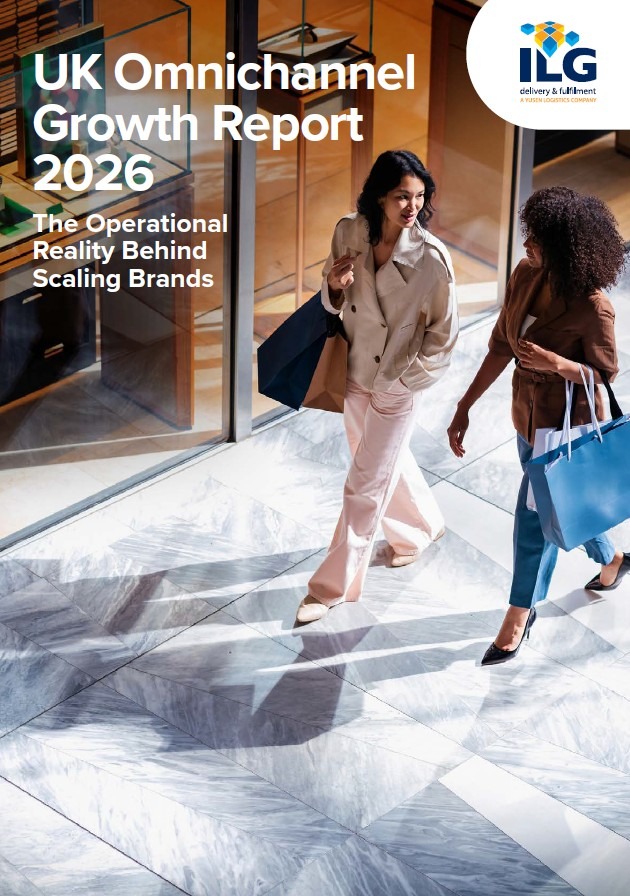
New retail industry report reveals operational challenges are overtaking marketing as the key constraint on growth
UK e-commerce brands are no longer struggling to generate demand they are struggling to fulfil it. New research from ILG analysing the operational challenges facing UK e-commerce brands has found that fulfilment costs and operational pressures are now overtaking marketing as the biggest barriers to growth.
The study, based on a survey of 328 founders, CEOs, COOs and Operations Directors across UK consumer brands, found that 53% cite fulfilment costs as a major barrier to growth, closely followed by 54% who highlight rising business costs. Whilst marketing has long been seen as the primary growth constraint, By contrast, only 10% of brands now identify customer acquisition costs as their primary challenge compared to over half pointing to fulfilment costs.
The findings suggest a significant shift in the economics of e-commerce, with operational execution now playing a larger role in determining whether brands can scale successfully.
Global e-commerce is now valued at more than $3.6 trillion, and UK brands continue to expand into new channels and markets at pace. However, the research indicates that the operational demands of modern omnichannel retail including cross-border logistics, data integration and rising delivery expectations, are creating genuine pressures behind the scenes.
The report, The UK Omnichannel Growth Report 2026 highlights that more complicated operations are emerging as one of the defining challenges for scaling brands.
Alongside rising costs, the survey identified operational bottlenecks are hindering growth including:
- Data integration between platforms and fulfilment partners was the most commonly cited technical challenge
- International returns handling remains a major issue for over a third of brands
- Inventory visibility and stock accuracy are becoming harder to maintain as companies scale
- Returns continue to impact sectors such as fashion, beauty and consumer electronics particularly with the current economic climate
Despite these pressures, most brands remain confident in their current fulfilment setup. More than 80% describe themselves as mostly or extremely confident, although nearly half say their systems work, but with gaps or inconsistencies.
This suggests that while operational models are functioning today, many may struggle to keep pace as businesses grow across multiple markets and channels.
According to the research, mid-sized brands with revenues between £5 million and £20 million show the strongest combination of international growth ambition and operational strain, particularly around cross-border logistics, tariffs, returns and data integration.
The report also found that companies are increasingly investing in operational technology to address these challenges. More than 45% of respondents say AI-driven operational improvements such as demand forecasting, routing optimisation and automated customer communication are a key investment priority over the next 12 months.
Commenting on the findings, Tom Ashley, CEO of International Logistics Group (ILG), said:
“For years, brands have focused on demand generation as the key to growth. What this data shows is that demand is no longer the constraint, execution is.”
“Having brilliant marketing isn’t enough anymore, the brands that will win over the next five years are the ones that can operationalise growth across multiple markets without losing control of cost, service or visibility.
“E-commerce is still growing strongly, but the operational bar has risen dramatically. The challenge for many brands is no longer generating demand, it’s the nurturing of that growth efficiently across multiple channels, markets and delivery networks.”
“What we’re seeing is a shift in focus. Businesses are investing more in fulfilment infrastructure, delivery flexibility and operational visibility because those capabilities increasingly determine how far they can scale.”
The research suggests that many brands are responding by strengthening operational foundations rather than focusing solely on marketing or expansion initiatives.
As e-commerce matures, fulfilment and delivery are becoming central to customer experience, cost control and international growth.
The report concludes that operational excellence including fulfilment performance, delivery flexibility and supply chain resilience, is increasingly emerging as a competitive advantage for brands operating in the modern retail environment.
The report suggests that this shift will reshape how brands invest over the next 3–5 years, with fulfilment, delivery and operational technology becoming central to competitive advantage rather than a back-end function.