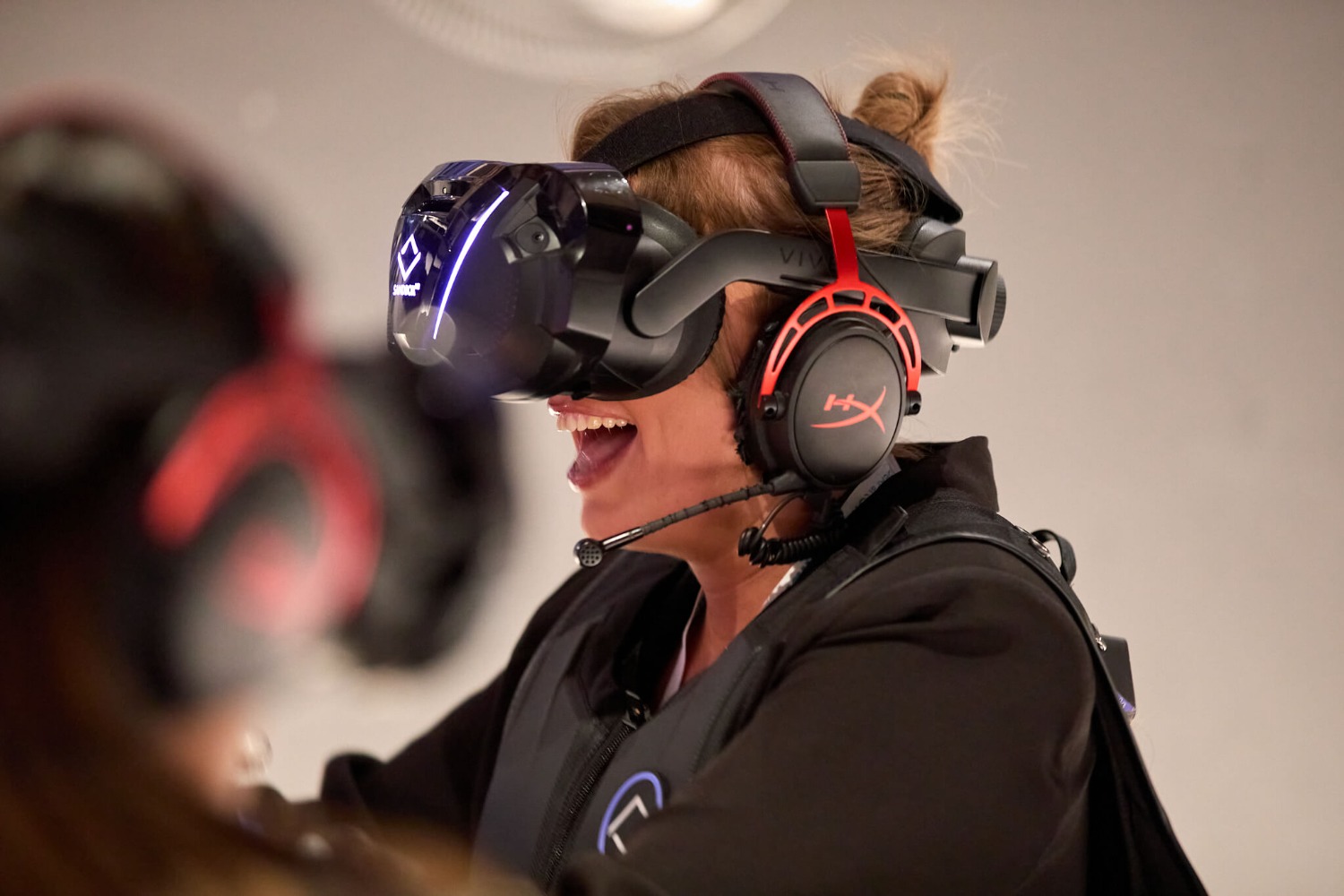
Hundreds of school children from across the Midlands will step out of the classroom and into the prehistoric age this winter, thanks to a brand new partnership between Sandbox VR and the Natural History Museum. Beyond the adventure, it puts immersive learning to work, an approach research links to stronger understanding, recall and engagement with science.
Children learn far more from what they do than from what they are told, and children today grow up immersed in technology.. In one international study of two to five year olds, more could play a computer game than could tie their own shoelaces, 58 per cent against 9 per cent.
Age of Dinosaurs, developed with some of the world’s leading dinosaur experts, takes small groups on a guided expedition into a Jurassic world where prehistoric life is explored rather than simply read about. Over roughly 30 minutes, groups of up to six work together to complete their mission, guided by Aluna, an explorer from the future, and her robot dog Chrono. They navigate difficult terrain and come face to face with a towering Brachiosaurus, a hungry Triceratops and the fearsome Tyrannosaurus Rex. The experience is built for teams, so children communicate, plan and solve problems together throughout. Every creature and habitat has been shaped by expert input, so what children encounter reflects the current scientific understanding of how these animals looked, moved, sounded and lived.
Dr Darren Naish, Palaeontologist and Lead Scientific Consultant at the Natural History Museum, said: “It’s the dream of every dinosaur expert to help bring these amazing animals to life. We’ve done everything we can to portray dinosaurs, their contemporaries and their world according to current scientific understanding.
“I’m thrilled with the vibrant, exciting event we’ve created and hope you enjoy it as much as I’ve loved seeing it all come together.”
A systematic review of more than 100 studies into immersive technology in school-age STEM learning found that it helps pupils visualise complex concepts, sustain engagement and build more positive attitudes towards science, technology, engineering and maths. Immersive environments make abstract ideas concrete, letting learners explore processes and places no classroom could recreate, which supports deeper understanding and stronger recall. Because pupils take part rather than simply watch, virtual reality has been shown to lift engagement, including among children who find traditional lessons hardest to connect with. Studies have also found that hands-on virtual encounters raise interest in science and shape how children picture their future careers, at a time when drawing more young people into science and technology remains a national priority.
That priority is now reflected in national policy: from September 2028, new technical education routes will let pupils from Year 10 combine core subjects including science with skills training linked to local jobs, reforms that build on the Greater Manchester Baccalaureate introduced under Andy Burnham.
Unlike traditional virtual reality, which relies on a single headset, Sandbox VR uses the same full-body motion capture found in Hollywood productions, so players see and interact with one another as though they were really there. Research points to that kind of collaboration and peer learning as a strength of immersive education.
Andy Scanlon, Owner of Sandbox VR Birmingham, added: “Children have always been fascinated by dinosaurs. This partnership takes that fascination and turns it into something lasting, a first taste of the science behind the creatures they already love, and hopefully the start of a real interest in learning.”
Age of Dinosaurs is now available at Sandbox VR Birmingham.
Schools and families can find out more at sandboxvr.com/birmingham.