Yorkshire-based children’s cancer charity Candlelighters has provided an update on the pioneering work of the Candlelighters Supportive Care Research Centre (CSCRC), launched two years ago, in partnership with The University of York.
Candlelighters provided early commitment to opening the £1 million Supportive Care Research Centre, which looks at improving the care surrounding cancer treatment. It includes treating side effects, managing pain, and reducing infection.
The CSCRC, in partnership with the Centre for Reviews and Dissemination at The University of York, is led by Professor Bob Phillips. He is one of the world’s leading experts in childhood cancer research.
Bob is also a paediatric oncology consultant at Leeds Children’s Hospital. He says: “A startling statistic is that of all children who sadly die with cancer, one in three die not because of the cancer itself, but because of the side effects of their treatment. Worse still, research into reducing these side effects for children is under-resourced, sparse, and inadequate.”
“So, it’s important to have the right supportive care surrounding the treatment. Managing the side effects will mean children are less affected by their treatment, they’ll have fewer long-term impacts, and ultimately, they’ll be more likely to survive.”
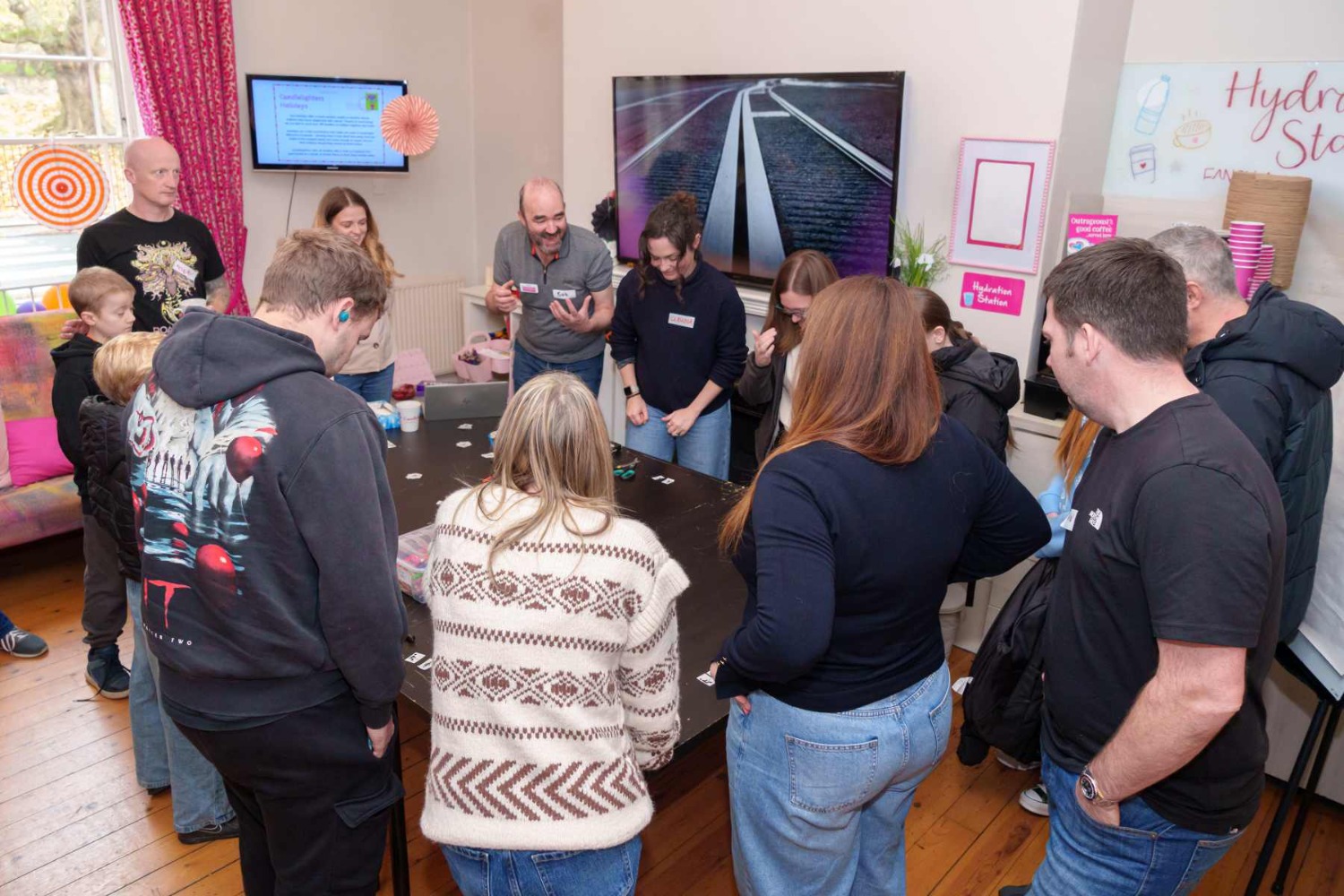
One of the many activities undertaken by Candlelighters Supportive Care Research Centre, is the Patient Family Involvement Research Groups, run at the Candlelighters family support centre in Leeds.
The purpose of the groups is for children and young people with cancer, and their families, to come along to discuss what research is important to them. Researchers speak to them about the studies they are planning, to get the thoughts and opinions of the children, young people, and parents, on how to make the studies better, and to help with communication about the results of these studies.
Commenting on the patient family involvement research groups, Professor Bob Phillips says: “These are really interactive and thoughtful sessions, which draw on the expertise and experience of childhood cancer patients and their parents. This work helps us to improve and prioritise the research work needed to improve supportive care for children and young people with cancer.”
Bob explains that the work of the groups has been recognised with awards and has also attracted international attention: “Researchers from around the world want to include the considerations from the group in their planned works. It’s highly unusual and very positive to have a group where patients and parents are so engaged.”
The centre has driven forward numerous studies and projects to improve the lives of children and young people with cancer over the last two years. Some of the research that has been progressed at the Candlelighters Supportive Care Research Centre has been driven by what has come out of the patient family involvement research groups. These include separate funding of £700,000, led by Dr Jess Morgan, Deputy Director of the centre, to lead an ambulatory (at home) chemotherapy research programme for children and young people at Leeds Children’s Hospital and the Centre for Reviews and Dissemination.
In addition, the centre has contributed to the publication of new international guidelines increasing the range of foods children and young people can eat during treatment, to improve nutrition and mental wellbeing. It is also progressing work to standardise the treatment across the UK of mucositis, debilitating mouth blistering caused by chemotherapy, using highly effective red-light treatment to ease the effects.
Bob adds: “The value and influence of the patient groups continue to grow, and Candlelighters is asking people who’ve experienced childhood cancer, to come along and help understand what the experience of going through that is like, and how things can be improved.”
Emily Wragg, CEO of Candlelighters says: “More than 2,400 children and teenagers are diagnosed with cancer in the UK each year. Amazing progress has been made in understanding and treating childhood cancers. Today, around 80% of children or young people diagnosed with cancer will survive. This is an incredibly encouraging statistic, but despite advances in curative medicine, little has been done to improve the experience of living through and beyond cancer.
“Initial investment from Candlelighters enabled the opening of the groundbreaking Candlelighters Supportive Care Research Centre – the first dedicated centre in the world to focus on improving care for children with cancer.
“Less than 5% of all cancer research is spent researching the care needs of cancer patients, especially young people, and how best to meet them. We are funding research that most others don’t, in this vital yet underfunded area of cancer care.”
Emily adds: “In only the first two years, the Candlelighters Supportive Care Research Centre has made great strides by driving forward new research, forming academic partnerships, and enabling further studies in children’s supportive cancer care. We continue to seek funding to sustain this momentum and expand our impact, for the thousands of lives it will improve, save, and transform.”
Learn more about what Candlelighters do, and how you can make a difference for children and young people: https://www.candlelighters.org.uk/howyoucanhelp/
Case studies
Parents of children and young people with cancer have spoken of their involvement with the Patient Family Involvement Research Groups, run at the Candlelighters family support centre in Leeds.
Shaun was diagnosed with acute lymphoblastic leukaemia in April 2015, aged five. He underwent treatment and a stem cell transplant which was initially successful, but sadly he relapsed and died in June 2017.
Since then, Shaun’s mum, Tina, has channelled her experience into supporting research that can improve care for other children. Taking part in the Patient and Family Involvement research groups at Candlelighters helps her carry forward Shaun’s legacy and ensure his experiences make a difference.
“Research is so important to us as a family. Without it, we wouldn’t have had the time that we had with Shaun. So even though he’s not benefiting from it now, he did benefit from it. We probably had two and a half years more than we would have done. Children many years ago with Shaun’s diagnosis would have died very quickly.”
Mucositis, for example, was something he suffered really badly with. Being involved with new treatments like the red-light therapy, which was the focus of a recent research group, makes me feel positive that children in the future aren’t going to go through what Shaun went through. The PPI groups are a really important way for children now to have a voice.”
In August 2023, 11-year-old Joshua received the diagnosis of cancer. His aggressive lymphoma required intensive chemotherapy treatment and a four-month stay in Leeds General Infirmary.
Two years on, Josh is recovering well and the whole family have been doing everything they can to raise money and awareness of childhood cancer. Helen and Gavin, Josh’s mum and dad, explain why all three of them have been taking part in the research groups.
“We’re about to embark on our third group. I think we’re the kind of people, Josh included, that if we can make a small fraction of someone’s experience better, then we feel it’s our obligation to try and help.
“The group sessions are great. They’re a mixture of updates as to where the research studies are up to, and then they get our experiences and opinions on things, including the kids. There are families with completely different experiences, different diagnoses, different treatments and different outcomes, so you get such a lot of different perspectives.
“Our journey with research started when Josh was in isolation. He did a video of him using the red light therapy on himself, to show it’s nothing to be afraid of, and we did an interview about what it was like. It was something we really benefited from, so it was really important to us that we tried to do as much as we could, so that other families didn’t have to go through the same complications with mucositis that Josh did.”
Hearing that things are actually changing or being put in place because of the research groups and the Supportive Care Research Centre, it’s amazing. Knowing that we are helping to shape things, even if it helps just one patient or family, that’s mission accomplished for us.”