An examination of Dream Home Store’s range finds a thoughtful response to smaller rooms, changing storage habits and the return of upholstered bedroom furniture.
— A bed claims more space than almost any other bedroom object, yet conventional frames do little with the area beneath the mattress. That dormant footprint is harder to defend as British homes accommodate more belongings and, increasingly, more than one purpose per room.
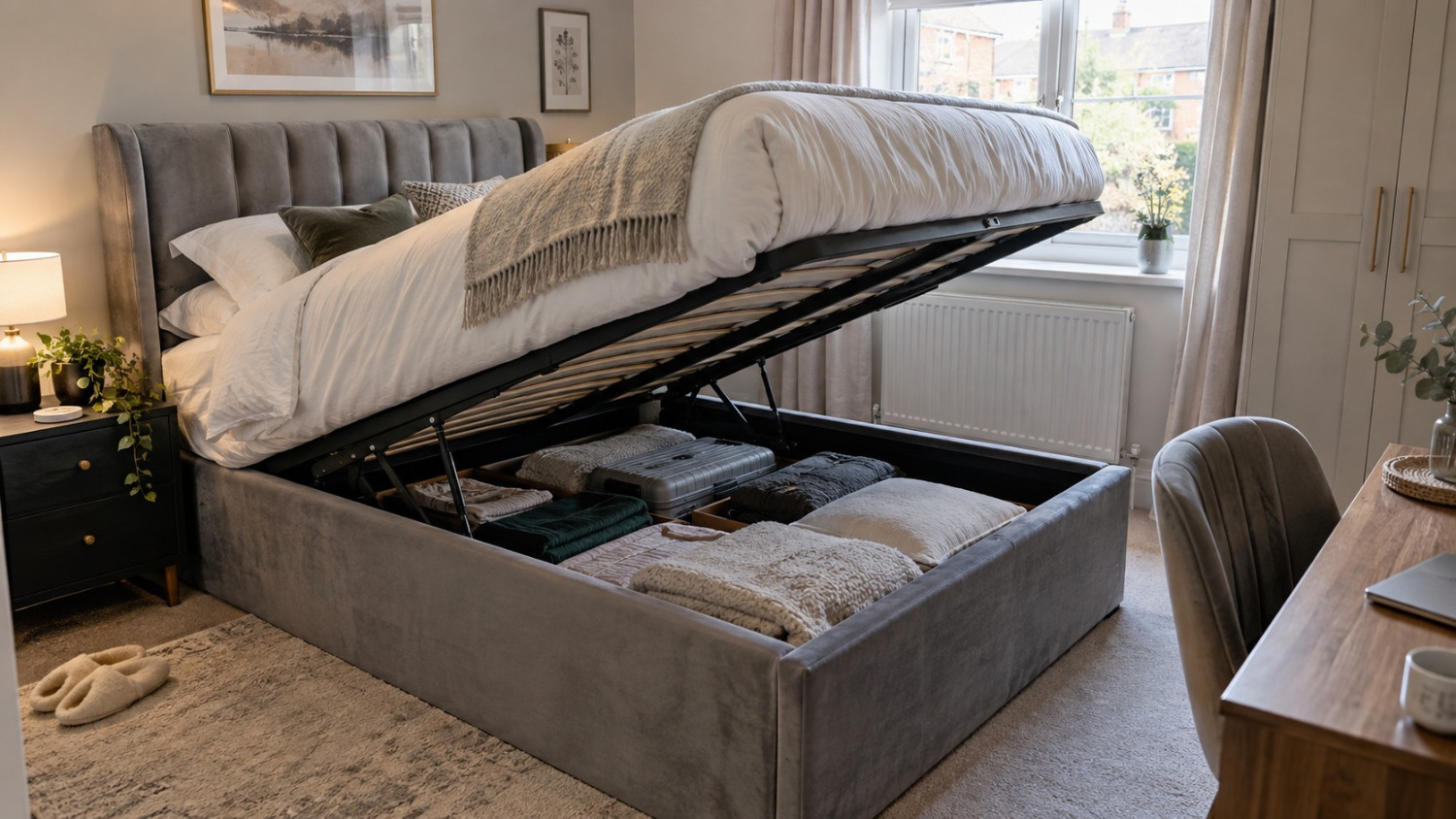
This explains the renewed popularity of ottoman beds. Instead of adding visible drawers, an ottoman frame lifts the mattress platform to reveal storage below. It is a simple idea, but the result depends on decisions less obvious in photographs: which way the base opens, how much clearance it needs and whether the upholstery will dominate the room.
I examined the DHS Ottoman Bed Collection to determine whether it addresses those questions or repeats one mechanism beneath different headboards. My conclusion is favourable, with qualifications. The range is visually coherent, but its strongest feature is the opportunity to match size and lift direction to a real room.
Storage as part of the room
An ottoman storage bed makes spatial sense because the mattress already occupies the floor above it. Bedding, seasonal clothes and luggage can be stored without another chest of drawers or a crowded wardrobe. Unlike loose boxes, everything remains concealed; unlike many under-bed drawers, access does not depend on clear space along both sides.
DHS says its gas-assisted systems help raise the mattress base and hold it open. The mechanism reduces effort but not the need to plan. A side-lift frame helps when furniture stands near the foot; an end lift needs a clear approach. An end lift ottoman single bed may fit a narrow room beautifully yet prove inconvenient if its footboard almost meets a desk.
That breadth is important because the opening mechanism is not a minor specification; it determines how naturally the storage fits into daily movement and furniture placement elsewhere within the bedroom itself.
What shoppers’ searches reveal
Some of the clearest evidence about modern bedrooms lies in the language people use when searching. The query “single ottoman bed uk” is rarely just about sleeping width; it usually signals a box room, a child’s bedroom or a guest space where every centimetre needs a purpose. Small double ottoman beds address the next problem up: creating more sleeping room for one person without moving immediately to a full double footprint.
The familiar name can still obscure the measurement. A 4ft small double ottoman bed frame describes the sleeping width more usefully than “small double” alone, although buyers must also allow for the upholstered surround and headboard. Those seeking small double ottoman beds with mattress should check whether the mattress is genuinely included in the selected package, then confirm its depth and weight are appropriate for the lifting mechanism.
Even clumsier search phrases can carry useful intent. Someone entering “ottoman bed frame for sale uk” may be looking for little more than a retailer, but the search should lead to questions about assembled dimensions, delivery access and opening clearance. Meanwhile, “ottoman storage bed small double” is often shorthand for a very specific compromise: maximum concealed storage in a room that cannot comfortably accept a standard double.
At the larger end, king-size ottoman beds offer two gains at once: a broader sleeping surface and a substantially larger compartment. The clipped query “king size bed frame ottoman” reflects that dual priority, while “ottoman bed uk king size” often leads shoppers towards upholstered frames that provide storage without resembling a utilitarian divan. A deep base ottoman king size bed can act almost like a horizontal wardrobe, although owners should organise it carefully if they expect to retrieve items frequently.
An ottoman super king size bed offers the greatest capacity, but it also makes measurement most important. DHS lists an approximate super king footprint of 214 by 190 centimetres for relevant models, with individual designs varying. That can provide generous sleeping and storage space in a substantial bedroom; in a marginal room, it can simply trade visible clutter for cramped walkways.
From engineering to appearance
Storage beds can look heavy because their bases extend close to the floor. DHS counters that visual mass through upholstery, stitching, and varied headboard shapes. Vertical channels introduce order, square panels feel architectural, and sunrise patterns create movement. Chesterfield-inspired buttoning brings a more traditional character, while curved bouclé designs soften the outline. Winged frames make a stronger statement, and simpler models sit more quietly beside patterned wallpaper or prominent wardrobes.
Grey velvet ottomans remain an understandable centre of the range. Grey adapts to changing colour schemes, while velvet reflects enough light to prevent a large upholstered base from appearing completely flat. The grey velvet double ottoman bed with winged headboard represents the most dramatic expression of that formula: practical storage below and a hotel-like focal point above. Its wings add presence, but also external width, so they need to be included in the room plan.
The alternatives are meaningful rather than cosmetic. Linen-effect upholstery produces a cooler, less formal impression and is likely to suit relaxed interiors. Bouclé adds tactile depth to rounded forms without the sheen of velvet. This choice matters especially when a small-double storage frame will be the dominant object in a compact room. A quiet neutral can make the frame recede; stronger texture can turn the same volume into a deliberate feature.
A positive verdict, with practical caveats
No investigation of this category should ignore its compromises. Upholstered frames require more care than plain metal or timber. A storage compartment can become a place where possessions are forgotten rather than organised. Buyers need to verify mattress inclusion, check package access through halls and stairs, and leave enough room to raise the platform fully. Product images showing several colours and configurations also make careful option selection essential.
DHS nevertheless emerges positively because its collection anticipates many of these trade-offs. It spans space-conscious single and small-double formats through double, king and super king sizes. Side- and end-opening choices acknowledge that access matters as much as capacity. The visual range moves from restrained channelled headboards to winged, buttoned and curved designs, while velvet, linen-style and bouclé finishes give shoppers genuine decorative alternatives.
The company also states that its upholstered beds comply with relevant UK fire-safety requirements and promotes mainland delivery, price-matching and a 30-day return framework. As with any furniture purchase, customers should read the current product and policy terms rather than relying on a collection-page summary.
The larger finding is that DHS understands the ottoman bed as part of a room rather than a freestanding novelty. The collection does not reinvent the mechanism; it interprets it across credible spatial and stylistic choices. For buyers who measure carefully, select the opening direction deliberately and resist choosing size by aspiration alone, that approach offers an intelligent exchange: one substantial footprint, two useful functions and considerably less visible clutter.