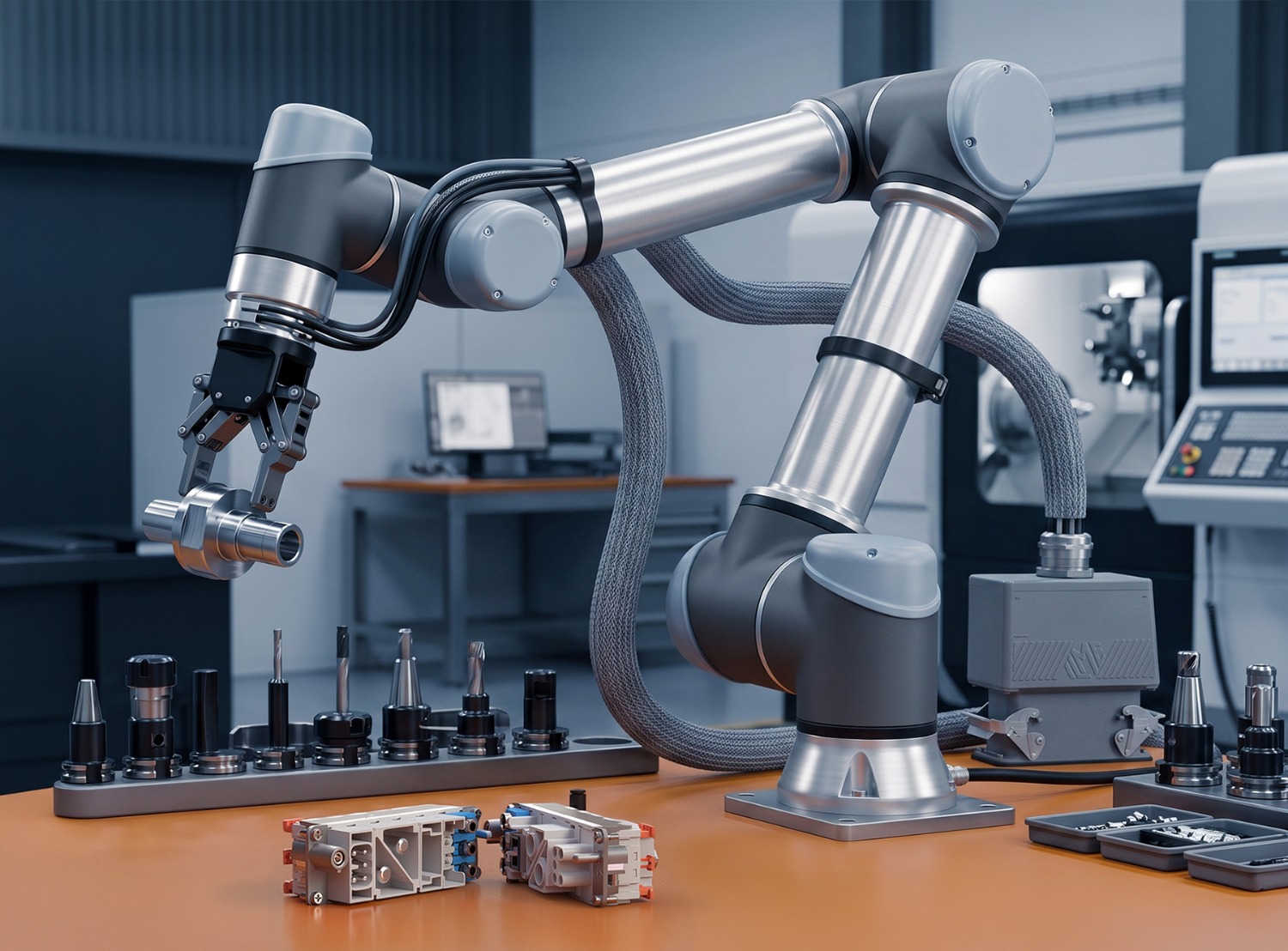
Collaborative robots combine mechanical movement with motors, sensors, controls, feedback devices, and communication systems. Each function requires an electrical connection, but those connections do not necessarily have the same requirements.
Power circuits may require different contacts and conductors than low-voltage signal circuits, while communication networks may require specialized connectors, shielding, and conductors to support reliable data transmission. When each function uses a separate cable and connector, the resulting wiring architecture can become increasingly complex within a compact machine. This complexity has led engineers to examine interconnect consolidation: organizing compatible electrical functions within a common connection architecture.
What a Hybrid Connector Actually Is
In industrial terms, a hybrid connector can consist of a common housing or frame containing different connector inserts or modules. One section may accommodate power contacts while another handles signal or data connections. Modular systems can arrange different inserts within a shared frame.
Rectangular connectors, such as ILME MIXO modular system, illustrates this approach, with modules designed for functions including power, signal, data transmission, optical signals, and pneumatic connections. They can be configured with modules for different electrical functions, allowing power and signal connections to be accommodated within the same connector frame. The objective is not to combine unrelated circuits indiscriminately. Each circuit must continue to meet its own electrical, mechanical, and environmental requirements.
Evaluating Which Functions Can Share an Interface
For robotic equipment, engineers can first identify the circuits that must cross an interface between machine assemblies. They can then determine whether compatible power, signal, or data functions can be accommodated within a common connector housing or modular frame. Cable construction, conductor size, shielding, strain relief, signal requirements, environmental exposure, and mechanical movement remain part of that evaluation. A consolidated connector does not automatically determine cable weight, bend radius, flexibility, or fatigue performance. Those characteristics depend on the complete cable and mechanical design.
Designing the Interconnect Around the Machine
As robotic systems become more integrated, the organization of power, signal, and data connections becomes part of the overall machine architecture. Hybrid connector systems provide one method for managing that complexity. Their suitability depends on the electrical and mechanical requirements of the equipment. The broader design shift is not simply toward fewer connectors. It is toward treating contacts, inserts, housings, cables, routing, and service requirements as parts of the same interconnect system.