As global regulatory bodies tighten safety requirements for food and medical packaging, a foundational scientific method is undergoing a high-tech transformation. Residue after evaporation (RAE) testing—a cornerstone of chemical purity for decades—is moving from manual laboratory beakers to fully automated, high-precision systems to meet the demands of modern safety standards.
What is Residue After Evaporation?
Residue after evaporation (RAE), also known as Non-Volatile Matter (NVM), Residue on Evaporation (ROE), or Total Migration, refers to the substances that remain after a liquid sample (such as water, chemical reagents, or food stimulants) has been completely evaporated and dried under specific conditions.
The Residue after evaporation test originated from the field of Gravimetric Analysis, one of the most fundamental branches of analytical chemistry. Unlike many modern tests that rely on electronic sensors, RAE is a classical “wet chemistry” technique based on the physical law of conservation of mass.
What Areas & Industries Require This Test
- Food Packaging: To test the “Total Migration” of chemicals from plastic films, coatings, or containers into food stimulants (like oil, alcohol, or acidic water). This ensures the food remains safe for consumption. EN 1186 (Europe), FDA 21 CFR (USA), GB 31604.8 (China)
- Medical Devices:ISO 1135, ISO 3826 (Plastics for medical/blood use)
- Pharmaceuticals: To test the purity of Purified Water or the safety of intravenous (IV) bags, tubing, and bottles. It ensures no harmful plastic extracts enter the bloodstream. USP <661> (Plastic Packaging Systems), The US Pharmacopeia introduced Non-Volatile Residue (NVR) tests to ensure that plastic containers (like IV bags) do not “leach” chemicals into the medicine, which could be life-threatening for a patient. EP (European Pharmacopoeia)
- Chemical Industry: To verify the purity of reagents. ISO 759 (Volatile liquids for industrial use), ASTM D1353(paint and solvent industries)
Why is it the Safety Gatekeeper
The objective is to quantify the amount of non-volatile substances in a solvent to ensure purity or safety. In the context of packaging, this test measures how much substance (monomers, additives, plasticizers, or contaminants) leaches out of the packaging material into the food and drinks it holds.
As international regulatory bodies such as the FDA, ISO, and USP tighten their requirements for food and medical safety, the industry is shifting toward next-generation systems to ensure purity at the sub-milligram level.
How the test is performed in old-school way
- Preparation: The sample (e.g., a chemical reagent or a food simulant that was in contact with a plastic film) is placed in a clean, pre-weighed container.
- Evaporation: The liquid is heated (often via a water bath) until all volatile components have evaporated.
- Drying: The remaining residue is dried in an oven to a constant weight.
- Weighing: A microbalance measures the final weight of the residue.
- Calculation: The weight of the residue is calculated by subtracting the initial weight of the empty container from the final weight.
To perform this test accurately (often at the sub-milligram level), specialized equipment is needed:
- Evaporation Station (Water Bath): To safely evaporate solvents without scorching the residue.
- Drying Oven: To ensure all moisture is removed and the residue reaches a “constant weight.”
- Analytical Balance: Because the residue is often microscopic, a balance with a readability of 0.01 mg to 0.1 mg is required.
Next-Gen Automation
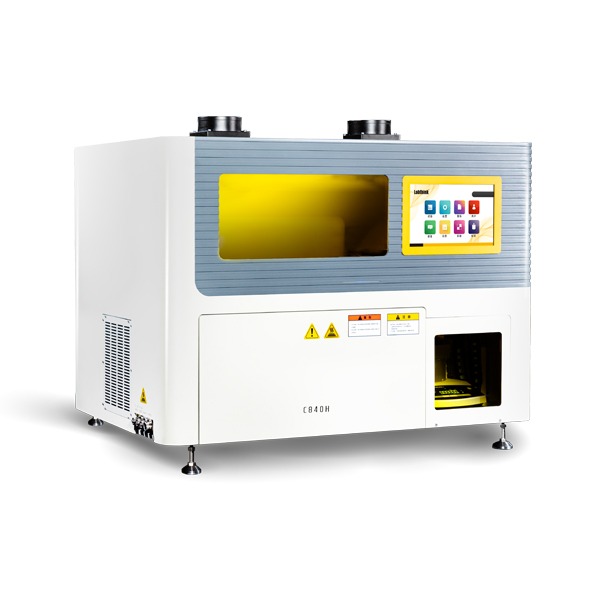
New technologies facilitate the integration of the evaporation, drying, and weighing phases into a single closed-loop environment, by doing so modern systems eliminate common sources of human error and environmental contamination. Plus high precise analytical balance with repeatability of 0.01 mg, the transition to automated systems represents a major leap forward in laboratory efficiency and test accuracy.
The test of Residue after evaporation is a distillation of two centuries of analytical chemistry. It transitioned from a basic lab technique into a global “safety gatekeeper.” When you use an integrated test system (e.g. Labthink C840H), you are essentially performing a Time-Tested experiment (evaporate and weigh) using Next-Generation precision (micro-balances and automation) to meet the legal “purity” requirements set by ISO, ASTM, and the USP.