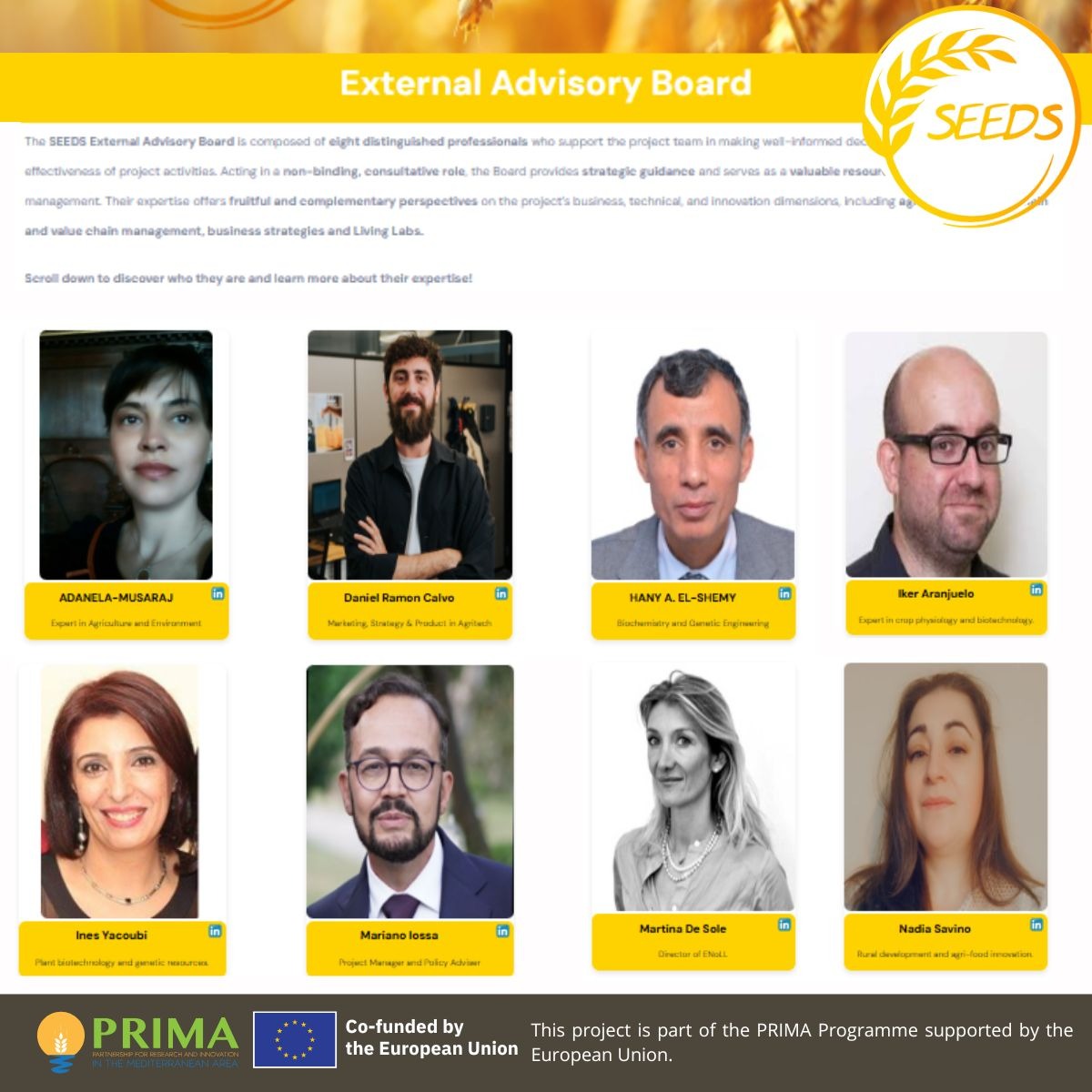
The SEEDS project, funded under the PRIMA Programme, has announced the establishment of its External Advisory Board, composed of eight leading international experts in agriculture, innovation management, and sustainability.
Following a rigorous selection process, the SEEDS consortium appointed a group of professionals who will act in a consultative and non-binding capacity, providing strategic, scientific, and operational advice to enhance the project’s overall impact.
The External Advisory Board will support the consortium’s senior management in refining its approach to agri-food innovation, with a particular focus on ancient crops, functional foods, value chain management, and Living Labs methodologies.
By integrating diverse expertise from academia, industry, and policy, the SEEDS External Advisory Board will contribute to ensuring that the project delivers meaningful, scalable solutions to foster food security and resilience in the Mediterranean region.
The full list of EAB members, along with their professional profiles, is available here.
About SEEDS
SEEDS, standing for Sustaining Economies and Enhancing Dynamic Structures, is a PRIMA-funded project coordinated by ENCO srl, with partners from across the Mediterranean. The project aims to revitalize ancient grains to enhance cereal supply and value chain resilience in the MENA region, particularly in Tunisia, Egypt, Morocco, and Jordan.
By reintroducing ancient grains, SEEDS is promoting agricultural biodiversity and reducing reliance on a limited set of grain crops. Through testing adaptability to current conditions and pests, SEEDS is working to provide evidence-based recommendations for increasing supply chain resilience and digitalization. Human participation is the heartbeat of the project, indeed, utilizing multi-criteria decision analysis, SEEDS is organizing Living Labs as local co-creation spaces in each MENA partner country involved.
SEEDS Living Labs are not just physical spaces, they are dynamic environments where most project activities take shape and evolve. These Labs provide a participatory framework where local stakeholders, including small farmers, families, and market actors, actively contribute to shaping research directions and solutions. Through this inclusive model, SEEDS integrates local knowledge, experience, and values to co-design resilient and culturally grounded agrifood solutions for the MENA region.
Moreover, SEEDS will transplant the AKIS model [1] for agricultural innovation in the MENA region. This model fosters sustainability and rural development by facilitating knowledge exchange, innovation dissemination, and user engagement. One of the main outputs of the project will be the digitalization of the AKIS model, transforming it into a user-friendly and accessible platform called INNOVakis, that will be involved into the SEEDS knowledge sharing center & Capacity building platform.
[1] Agricultural Knowledge and Innovation System.