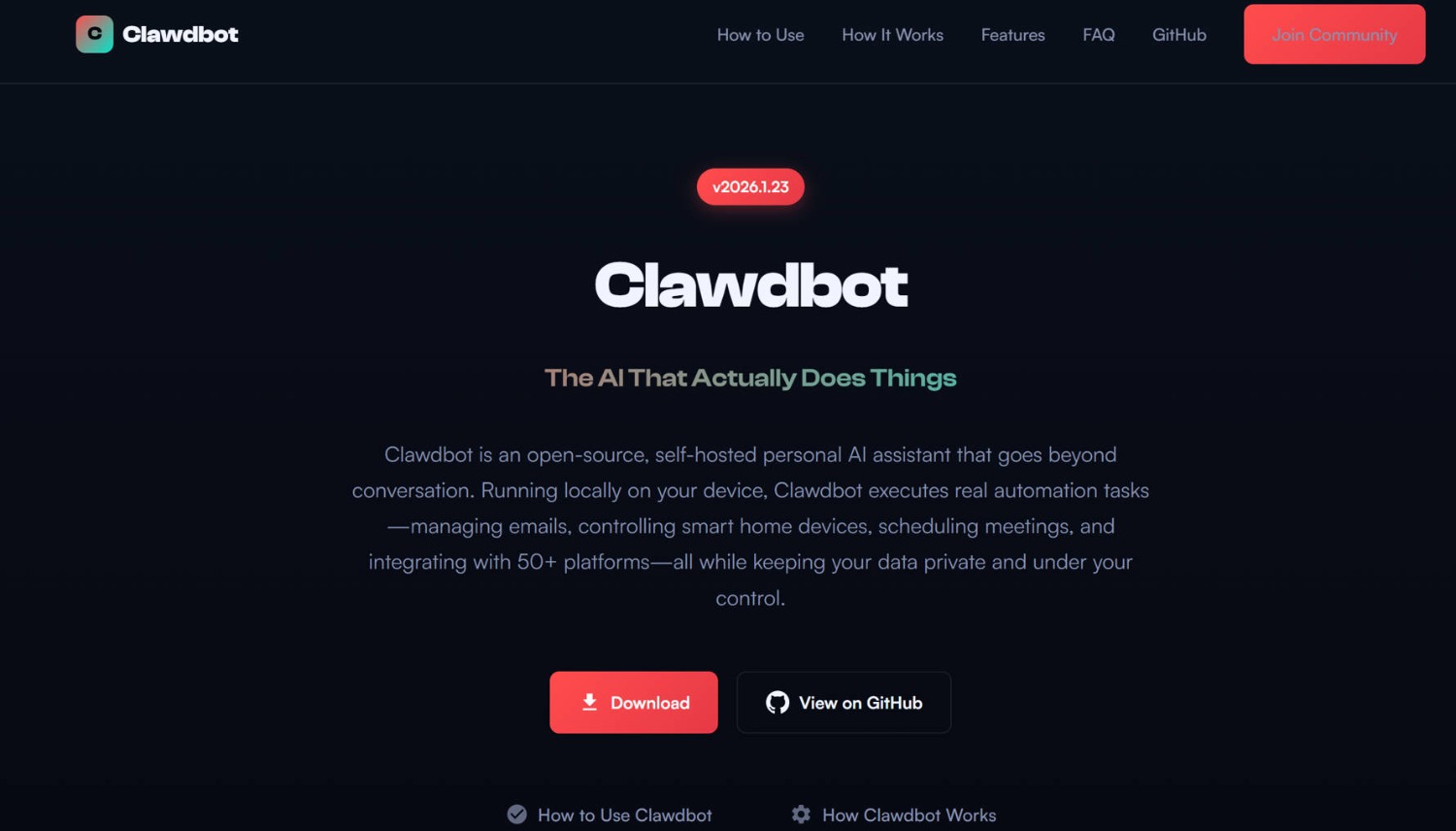
Clawdbot, an open-source personal AI assistant that executes real automation tasks locally on user devices, has reached a significant milestone with over 10,200 GitHub stars and an active community of 8,900+ members. The platform differentiates itself from conventional AI chatbots by performing actual tasks—managing emails, controlling smart home devices, scheduling meetings, and integrating with popular communication platforms—all while maintaining complete user privacy.
Privacy-First Architecture Sets New Standard
Unlike cloud-based AI assistants that process user data on remote servers, Clawdbot runs entirely on local devices, ensuring that personal information never leaves the user’s control. This privacy-first architecture addresses growing concerns about data sovereignty and third-party access to sensitive information.
“Clawdbot was designed from the ground up with privacy and control as core principles,” said Peter Steinberger, founder and lead developer of the project. “Users shouldn’t have to choose between powerful AI assistance and protecting their personal data.”
Steinberger, former founder and CEO of PSPDFKit, brings decades of experience building developer tools and enterprise software to the Clawdbot project.
Real Automation Beyond Conversation
The platform distinguishes itself through its ability to execute concrete tasks rather than simply providing conversational responses. Current capabilities include:
- Email Management: Automatically sorting, responding to, and organizing inbox messages
- Calendar Integration: Booking meetings, setting reminders, and managing schedules
- Smart Home Control: Integrating with Home Assistant and IoT devices for voice and text-based home automation
- Development Workflows: Code review, deployment management, and DevOps automation
- Data Processing: Spreadsheet analysis, report generation, and insight extraction
- Travel Management: Flight check-ins and reservation handling
Multi-Platform Communication
Clawdbot supports interaction through multiple communication channels, allowing users to access their AI assistant from their preferred messaging platforms. Supported integrations include WhatsApp, Telegram, Discord, Slack, iMessage, Signal, Matrix, and Mattermost.
The latest release (v2026.1.23) introduces expressive voice replies with model-driven text-to-speech, a new HTTP API for direct tool invocation, and expanded deployment options including one-click setup on Fly.io.
Flexible AI Model Support
The platform supports multiple AI model backends, giving users the flexibility to choose based on their specific needs for performance, cost, or privacy:
- Claude (Anthropic)
- GPT-4 (OpenAI)
- Local models via Ollama
- LM Studio integration
Users can switch between AI providers without reconfiguring their setup, enabling optimization for different use cases.
Extensible Skill System
Clawdbot features an extensible architecture that allows users to expand capabilities through the ClawdHub marketplace. Community members can install pre-built skills or create custom integrations tailored to their specific workflows and requirements.
Built-In Security Features
Security is fundamental to the Clawdbot architecture, incorporating:
- Sandboxed execution environments
- Configurable access controls
- User trust boundaries
- Enterprise-grade security features for safe automation
These protections ensure that automation tasks execute safely without compromising system integrity or user data.
Technical Foundation
The platform is built on a robust technical stack:
- Node.js 22+ runtime
- TypeScript codebase
- Docker containerization support
- Gateway-based central control plane
- WebSocket real-time communication
- Persistent memory via Markdown files
- Tailscale secure networking
Growing Open-Source Community
The project has attracted significant developer interest with over 50 contributors and 7,800+ commits. The active Discord community provides support, shares custom skills, and collaborates on feature development.
Clawdbot is released under the MIT License, allowing users to download, use, modify, and distribute the software freely. While the core platform is free, users may need to pay for AI model API access unless they choose to run local models.
Platform Availability
Clawdbot currently supports macOS as the primary platform through native installers (DMG and ZIP formats). Linux and Windows support is available through Docker deployment, enabling cross-platform usage for users with different operating system preferences.
The latest version (v2026.1.23) is available for download at https://clawdbot.you/ with comprehensive documentation, video tutorials, and setup guides.
Future Development
The development team continues to expand platform capabilities with regular updates addressing user feedback and adding new integrations. Recent additions include Tlon/Urbit channel support, AWS Bedrock auto-discovery for automatic model configuration, and per-channel visibility controls for heartbeat indicators.
Community and Support
Users can access support and contribute to the project through multiple channels:
- GitHub repository: https://github.com/steipete/clawdbot
- Discord community: 8,900+ active members
- Comprehensive documentation at docs.clawd.bot
- Video tutorial library covering installation, integrations, and advanced features
For more information about Clawdbot, including download links, documentation, and community resources, visit https://clawdbot.you/