Most leaders understand their function. Few understand the whole business.
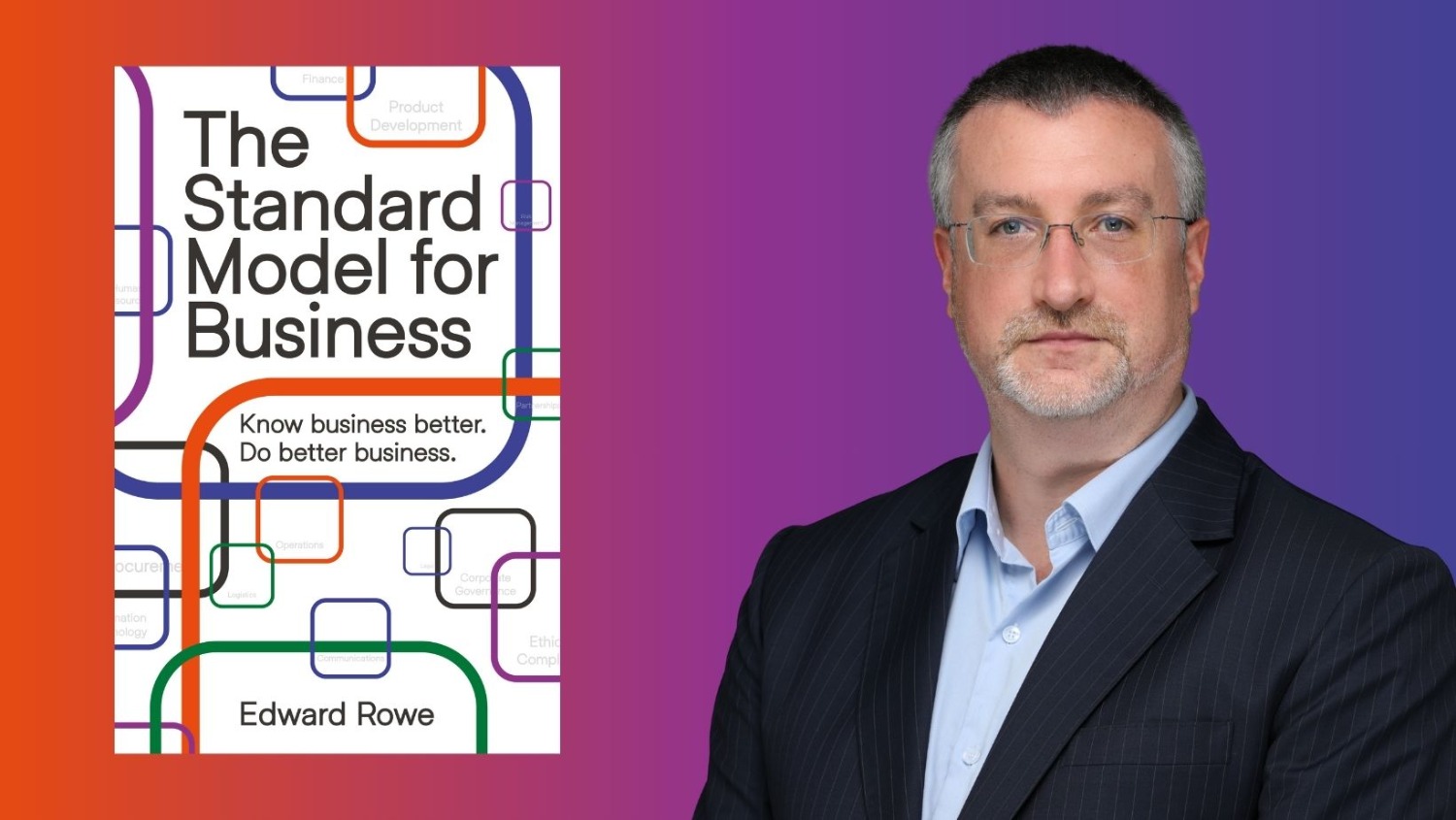
That gap is one of the most overlooked causes of misalignment in modern organisations. The Standard Model for Business (Rethink Press), the new book by governance expert Edward Rowe, directly addresses this gap with a practical framework for understanding how organisations really work.
Modern organisations are vastly complex: strategy, operations, people, capital, risk, and governance all interacting at once. Yet most leaders are equipped to manage one part, not to see how the entire system works. The result is predictable: inefficiency, misalignment, and decisions made in isolation. What’s missing is a coherent and consistent way of seeing the whole architecture.
Addressing this challenge, The Standard Model for Business introduces a new way of thinking about organisations: not as a collection of functions, but as a complete, interconnected system.
“We’ve trained leaders to specialise, but not to see the system,” says Rowe. “Most executives know their function deeply. Very few understand the enterprise.”
Within the book, Rowe sets out a clear framework designed around five stages of organisational development: Start, Stabilise, Grow, Govern, and Assure. Across these stages, twenty core business functions, from product development and operations to procurement and ethics & compliance, combine to form a comprehensive map of how organisations are built, scaled, and governed.
Rather than focusing on specific leadership styles or isolated best practices, The Standard Model for Business provides an end-to-end guide for seeing the enterprise at a systemic level. This model shows not only what it takes to build a resilient organisation, but how functions interconnect and how their importance shifts across stages of maturity. For Rowe, complexity isn’t the problem. The real problem is the lack of a logical structure to manage it.
Rowe also outlines how financing evolves alongside organisational maturity, from early-stage capital through to institutional funding, helping leaders scale in a controlled and sustainable way.
Drawing on more than two decades of global experience, The Standard Model for Business explores the real challenges organisations face as they expand, providing the context and insight needed for effective cross-functional decision-making.
“The companies that succeed long-term are not the ones with the best strategy on paper,” Rowe argues. “They are the ones that recognise how their business actually works.”
As organisations face increasing pressure to scale, transform, and operate in a complex world, the need for a clear, unified view of the enterprise has never been greater. For the ambitious professional, founder or senior leader seeking to move beyond functional expertise, The Standard Model for Business provides that mission-critical view.