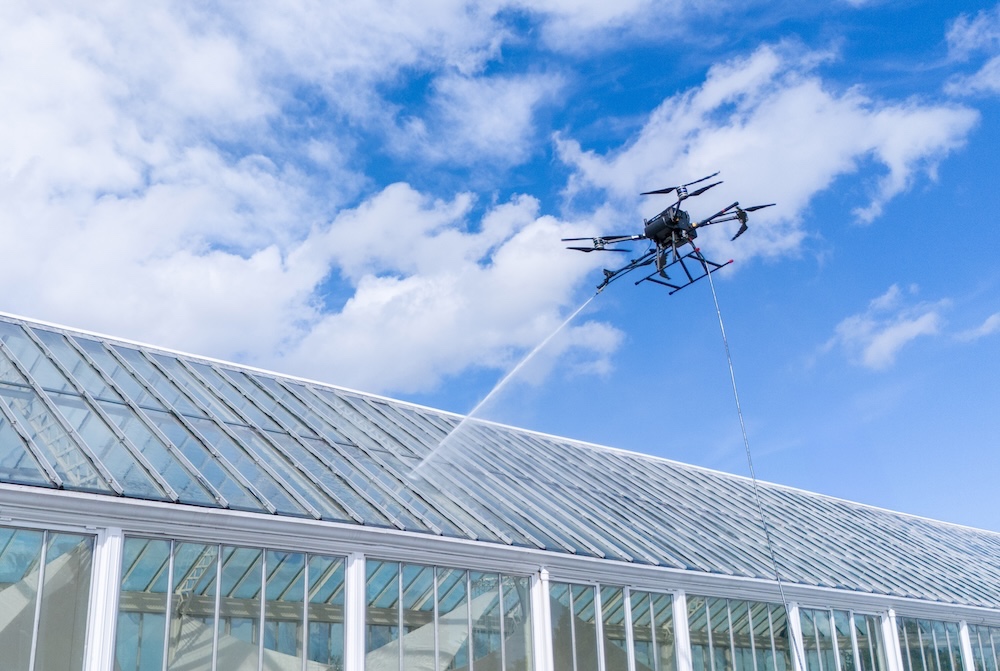
North of England company Hydrafly is showing how drone technology could make large-scale cleaning safer, faster and less disruptive.
Cleaning the outside of a large warehouse, industrial building or wind turbine can traditionally mean scaffolding, MEWPs, rope access and teams working at height. But a North of England company believes there is a smarter way.
Hydrafly, founded by Phill Rowark and Michael Kirby, is using high-pressure drone technology to clean difficult-to-access areas from the ground — potentially cutting project times by up to half on suitable applications.
The company officially launched in 2024 after its founders travelled to France to research and test the technology and complete manufacturer training. Since then, Hydrafly has been demonstrating how drones can provide a practical alternative to traditional access methods.
One recent project involved cleaning two logistics warehouses measuring approximately 3,500m² and 2,500m². Hydrafly completed the work in just four operational days, removing dirt, algae and environmental build-up from high-level façade cladding ahead of a site audit.
The company estimates the same project could have taken one to two weeks using traditional access methods, depending on equipment, team size and site conditions.
The difference is not simply speed. With no need to install scaffolding or repeatedly reposition access platforms, Hydrafly can mobilise quickly while reducing the number of people required to work at height.
The company’s system can operate at heights of up to 100 metres and in wind gusts of up to 31mph, creating potential applications across commercial buildings, industrial facilities and infrastructure — including wind turbines.
Phill Rowark, Co-Owner and UAV Pilot at Hydrafly, said the company is not suggesting traditional cleaning methods are no longer needed, but that there are many situations where they are not the most efficient option. “If a drone can do the job from the ground, why put people at height or spend days installing access equipment?” he said. “Our aim is to make cleaning more accurate, more efficient and safer, while reducing disruption for the customer.”
Co-owner and UAV pilot Michael Kirby added that when he and Rowark first saw drone cleaning being used successfully in Europe and America, they immediately recognised its potential for the UK. “What has really convinced us is seeing the results on large commercial sites,” he said. “The technology can change the whole approach to a job — from how quickly you can mobilise to how much equipment and manpower you need.”
Hydrafly is now expanding its work with commercial property owners, facilities managers, industrial businesses and infrastructure operators across the North of England and wider UK.
While drones will not replace every traditional cleaning method, Hydrafly believes they can offer a safer, faster and less disruptive alternative wherever high-level cleaning can be completed from the ground. By reducing the need for scaffolding, access platforms and prolonged work at height, the company is helping businesses rethink how large and difficult-to-reach structures are maintained.