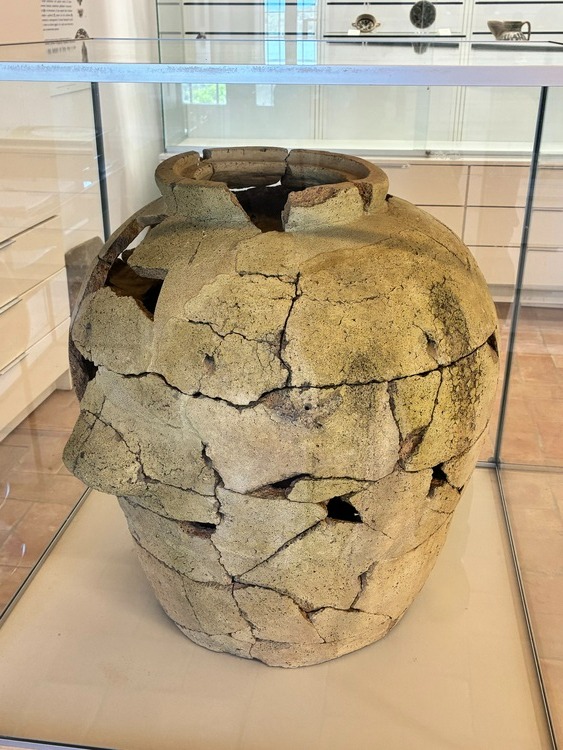
A rare Roman-era glirarium — a vessel used to raise dormice for the table — is now on public display at the Museo delle Maioliche Arcaiche, in the main square of Celleno’s ghost village, in Italy’s Viterbo province, roughly 90 minutes by car from Rome. The piece is one of only a handful of its kind preserved in Italy.
The glirarium is displayed alongside finds from a nearby archaeological site: a monumental Etruscan-era pit, roughly four meters deep, originally built as a water cistern and later reused in medieval times as a waste dump, giving rise to its Italian name, “butto.” Medieval ceramics recovered from the pit are shown together with the glirarium as part of Celleno’s “diffuse museum,” a network of exhibition spaces along the walking routes around the town’s Orsini Castle.
Dormice fattened in vessels like this one were served stuffed with minced pork, pepper, and pine nuts, then roasted. The dish was considered a luxury, typically reserved for banquets in wealthier Roman households.
Celleno’s ghost village is the town’s oldest quarter, abandoned after landslides made it unsafe.
Celleno’s mayor, Luca Beraldo, said the discovery connects the town to its history. “This discovery isn’t just archaeology — it’s about recovering who we are,” Beraldo said. “We are happy to welcome more and more tourists and visitors from all over Italy and around the world,” he added, citing new immersive technology introduced along the museum route.