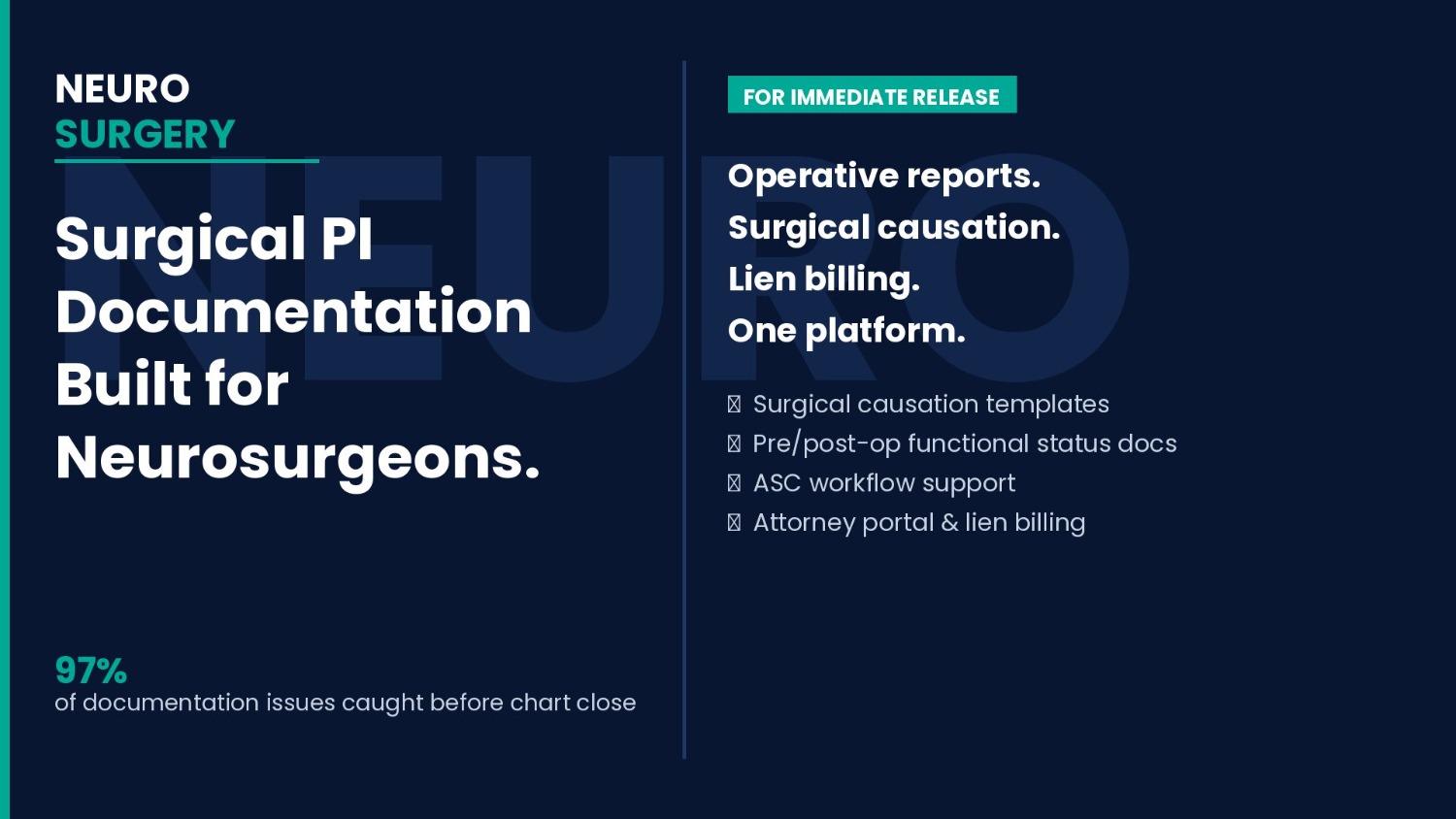
Ambula, the EMR platform built exclusively for personal injury clinics and ambulatory surgery centers, today announced a surgical documentation suite for neurosurgeons treating personal injury patients — including operative report templates with PI causation fields, pre/post-operative functional status documentation, surgical necessity narratives, and lien billing tools built for the settlement-based payment timelines of PI practice.
Why Neurosurgical PI Cases Demand More Than a Standard EMR
Neurosurgical PI cases — spinal fusion, discectomy, laminectomy, TBI craniotomy — carry among the highest settlement values in personal injury litigation. That value makes them primary targets for defense scrutiny. Defense experts attack surgical necessity, question whether the procedure was causally linked to the accident, and look for gaps between the operative report and the pre-surgical evaluation.
Standard EMRs generate operative reports designed for clinical records and insurance billing — not PI litigation. They have no mechanism for connecting the surgical findings to the accident mechanism, documenting pre-accident functional baseline versus post-accident surgical necessity, or formatting operative reports for PI legal proceedings. Neurosurgeons using general EMRs construct these narratives manually on every case, creating inconsistency and legal exposure at scale.
Purpose-Built for Neurosurgical PI Workflows
Ambula’s neurosurgical documentation suite includes:
- Surgical Causation Templates — Structured fields connecting surgical findings (herniated disc, spinal cord compression, intracranial hemorrhage) directly to accident mechanism, biomechanical injury pathway, and clinical necessity opinion — formatted for PI legal proceedings
- Operative Report PI Formatting — Pre-built operative note structure that documents surgical necessity, intraoperative findings correlated to traumatic injury, and post-operative prognosis in a format built for litigation, not just clinical records
- Pre/Post-Operative Functional Status — Structured documentation of pre-accident functional baseline versus post-accident surgical presentation, establishing the causal chain from accident to surgical intervention
- TBI Surgical Documentation — Operative templates for traumatic brain injury procedures including craniotomy and ICP monitoring, with structured causation fields connecting neurological deterioration to the accident mechanism
- Cross-Visit Consistency Auditing — Automated review of pre-op evaluations, operative notes, and post-op records for narrative consistency — catching 97% of documentation issues before the chart is closed
- ASC Integration — Full ambulatory surgery center workflow support including facility documentation, surgical scheduling, implant tracking, and ASC-specific billing — purpose-built for PI neurosurgeons operating at ASCs
Lien Billing for High-Value Surgical PI Cases
Neurosurgical PI cases operate entirely on medical liens and Letters of Protection — yet no standard EMR or surgical practice management system includes native tools to manage them. Ambula integrates digital lien and LOP signing into intake, auto-attaching executed documents to the case file with AR tracking built for settlement timelines.
Ambula’s attorney portal gives authorized PI attorneys direct access to operative reports, surgical billing statements, and post-operative records in real time — eliminating the 30–60 minute manual records requests that arrive daily in high-volume neurosurgical PI practices.
Results From PI Surgical Practices
- 8 minutes per chart vs. 20+ minute industry average for PI documentation
- 97% of legal-risk documentation issues caught before chart close
- 73% fewer data entry errors through digital patient intake
- 18% increase in collections from faster, cleaner documentation and lien billing
- 3.5x more PI cases handled with the same clinical staff
“Neurosurgical PI cases are the highest-value and most scrutinized cases in personal injury litigation,” said an Ambula spokesperson. “A spinal fusion without a documented causation chain, an operative report that doesn’t connect surgical findings to the accident mechanism — these are the vulnerabilities that cost neurosurgeons cases and credibility. Ambula closes those gaps on every chart.”