MicroMarketMonitor Projects Explosive 16% Annual Growth as Industry Transforms Into Critical National Infrastructure Asset
Industry Report Reveals $326.9 Billion Market by 2030 as Artificial Intelligence Reshapes Digital Infrastructure Landscape
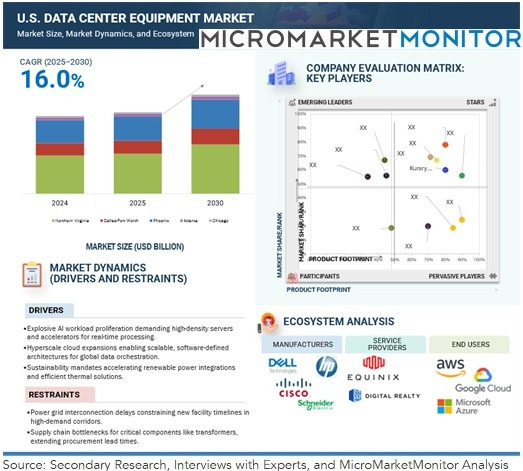
The U.S. data center equipment market stands at the precipice of unprecedented transformation, with new research from MicroMarketMonitor projecting the sector will more than double from $155.6 billion in 2025 to $326.9 billion by 2030—representing a remarkable compound annual growth rate of 16.0%. This explosive expansion positions data center infrastructure as a critical national asset, fundamentally reshaping how America processes, stores, and manages the exponential surge of digital information driving the modern economy.
Download PDF Brochure: https://www.micromarketmonitor.com/contact/9779436014-download_pdf_brochure.html
The findings emerge as artificial intelligence workloads, hyperscale cloud expansion, and edge computing requirements converge to create what industry analysts describe as a “perfect storm” of infrastructure demand. Major technology companies have committed over $200 billion in capital investments, with projects like OpenAI’s $500 billion Stargate initiative and Meta’s $65 billion data center allocation signaling an industry-wide recognition that tomorrow’s digital economy requires today’s infrastructure investments.
The AI-Powered Infrastructure Revolution
At the heart of this market transformation lies the relentless advancement of artificial intelligence technologies. Generative AI models and neural network training applications demand specialized computing infrastructure that far exceeds traditional data center capabilities. These sophisticated workloads require high-density server configurations, next-generation GPU accelerators, tensor processing units, and high-bandwidth memory systems capable of processing vast datasets with minimal latency.
“The artificial intelligence revolution is fundamentally rewriting the playbook for data center design and equipment procurement,” notes the MicroMarketMonitor analysis. Hyperscale operators are channeling massive capital into greenfield campus developments equipped with custom silicon and purpose-built AI infrastructure. This momentum extends beyond tech giants into enterprise sectors including finance, healthcare, logistics, and manufacturing, where hybrid cloud migrations enable legacy systems to incorporate real-time analytics and machine learning capabilities.
The shift toward AI-optimized infrastructure represents more than incremental improvement—it signals a complete architectural transformation. Modern facilities now target 50-100 megawatt power capacities compared to traditional 10-20 megawatt deployments, reflecting the enormous energy requirements of AI training clusters. These massive installations require clustered GPU resources that benefit from proximity and high-bandwidth interconnection, fundamentally altering facility design principles and equipment specifications.
Market Segments Driving Unprecedented Growth
Hyperscale Dominance and Edge Computing Acceleration
MicroMarketMonitor’s segmentation analysis reveals hyperscale facilities continuing to command the largest market share by architecture. These massive, purpose-built campuses optimize infrastructure for cloud providers and AI research facilities, integrating custom silicon, high-radix networking, and software-defined infrastructure to achieve extreme operational scale and efficiency.
However, the fastest-growing segment proves to be edge computing infrastructure, fueled by micro data centers and telecommunications edge nodes deployed in metropolitan areas and industrial environments. These compact, ruggedized systems support real-time AI inference for autonomous vehicles, smart city applications, and augmented reality platforms—all requiring sub-five-millisecond latency and resilient power delivery. Industry projections suggest edge infrastructure will experience the highest compound annual growth rate through 2030, driven by the proliferation of Internet of Things devices and 5G network expansion.
Colocation facilities serve as crucial bridges in this ecosystem, offering multi-tenant environments with shared power and cooling infrastructure, while enterprise data centers modernize legacy footprints with composable, hybrid-cloud-ready architectures. The diversity of deployment models reflects varied organizational needs, from cost-sensitive small and medium enterprises to hyperscalers demanding custom configurations.
Critical Equipment Categories and Technology Trends
The equipment landscape encompasses three primary system categories driving market value:
IT Infrastructure Systems include advanced compute platforms featuring specialized AI accelerators, high-performance servers with liquid cooling integration, storage systems optimized for massive data throughput, and high-bandwidth networking equipment supporting 400G and emerging 800G connectivity standards.
Power Infrastructure Systems encompass sophisticated electrical delivery mechanisms including intelligent rack power distribution units, medium/low-voltage switchgear, automatic transfer switches, backup generators utilizing diesel and natural gas, busway distribution systems, and advanced power monitoring software providing real-time visibility into energy consumption patterns.
Thermal Management Systems represent perhaps the fastest-evolving equipment category, with liquid cooling technologies gaining rapid adoption. Solutions include coolant distribution units, direct-to-chip cold plates, single-phase immersion tanks utilizing specialized dielectric fluids, along with traditional air cooling equipment such as computer room air conditioning units, in-row coolers, and sophisticated airflow management systems featuring hot/cold aisle containment.
Complementing these primary categories, heat rejection infrastructure including chillers, cooling towers, dry coolers, and heat exchangers work in concert to manage the unprecedented thermal loads generated by high-density computing environments.
Regional Dynamics and Power Infrastructure Challenges
The United States data center market exhibits stark regional concentration patterns, with Atlanta commanding the largest metropolitan market share at approximately 22% in 2024, according to converging industry analyses. Northern Virginia, historically the dominant market, absorbed over 450 megawatts of capacity in 2024, while Atlanta surpassed this benchmark with more than 700 megawatts of net absorption—marking the first time any market exceeded Northern Virginia’s annual capacity consumption.
Austin emerges as the fastest-growing region with projected compound annual growth exceeding 5% through 2030, driven by favorable tax policies, available land, and proactive utility partnerships. The southwestern corridor including Texas and Arizona contributes over 90% of the region’s data center investments, benefiting from business-friendly regulatory environments and abundant renewable energy resources.
However, this rapid expansion confronts significant infrastructure constraints. Equipment procurement timelines have extended dramatically, with generators and chillers facing 30-plus week lead times. Copper feeders and busway systems experience similar supply chain pressures due to global disruptions and surging demand from electrification initiatives across multiple industries. Equipment costs have escalated 40-50% since mid-2021, with specialized components experiencing even steeper price inflation.
These constraints force developers to secure equipment commitments earlier in project timelines and consider alternative sourcing strategies, including strategic manufacturing partnerships to guarantee supply continuity for large-scale deployments. The power infrastructure challenge extends beyond equipment availability to fundamental electrical grid capacity constraints, with some metropolitan markets experiencing unprecedented demand that outpaces utility infrastructure development.
The Sustainability Imperative and Energy Innovation
Environmental sustainability has emerged as a defining market characteristic, transforming from peripheral consideration to central strategic priority. Data center electricity consumption accounted for approximately 4.4% of national usage in 2023, with Department of Energy projections suggesting this figure could reach 6.7-12% by 2028 as AI workloads, domestic manufacturing, and sector-wide electrification accelerate.
This dramatic increase in power demand drives unprecedented innovation in energy sourcing and efficiency. Major operators including Microsoft, Amazon Web Services, and Google have signed power purchase agreements totaling thousands of megawatts of renewable energy capacity. Microsoft and Clearloop partnered in February 2025 to deploy 100 megawatts of solar projects across underinvested communities in Arkansas and Louisiana, while Google secured agreements to source carbon-free energy from Nebraska’s 420-megawatt Pierce County Energy Center, scheduled for 2027 operation.
Nuclear energy emerges as a potentially transformative power source, with both established reactor capacity and small modular reactor technology under active evaluation. The Department of Energy has identified multiple federal land sites—including Idaho National Laboratory and facilities in Kentucky and Ohio—for streamlined permitting to accelerate AI data center and clean power campus deployment. These initiatives combine infrastructure development with renewable energy resources including nuclear, solar, and wind generation.
Operational efficiency technologies complement renewable energy strategies. Liquid cooling systems, which can reduce energy consumption by 20-30% compared to traditional air cooling, are experiencing adoption rates approaching 170% growth between 2025-2030. Advanced cooling techniques including direct chip cooling with coolant distribution units and rear door heat exchangers in combination with dry coolers represent the cutting edge of thermal management innovation.
Competitive Landscape and Industry Leadership
The U.S. data center equipment market features a diverse ecosystem of global technology leaders, specialized manufacturers, and innovative startups. MicroMarketMonitor’s competitive analysis profiles major players including WESCO International, Schneider Electric, Dell Technologies, Hewlett Packard Enterprise, Caterpillar, Asetek, Chatsworth Products, Green Revolution Cooling, Proterial Cable America, Nexans, Stulz, Trane Technologies, Eaton, Starline (Legrand), Panduit, CommScope, and EAE USA.
Recent strategic developments illustrate the competitive intensity and innovation velocity characterizing the market. In January 2024, Dell Technologies launched the PowerEdge XE9785 server optimized for AI workloads with integrated liquid cooling, specifically targeting hyperscale facilities requiring enhanced thermal efficiency in high-density configurations. Hewlett Packard Enterprise announced a multi-year partnership for custom GreenLake edge solutions, deploying modular compute nodes across 50 U.S. locations.
Schneider Electric acquired a stake in a U.S.-based battery storage company to strengthen its EcoStruxure Microgrid solutions, aiming to seamlessly integrate renewable energy into data center power systems. These strategic moves reflect broader industry trends toward vertical integration, technology partnerships, and ecosystem development as competitive differentiators.
The market exhibits increasing consolidation as established players acquire specialized capabilities, while simultaneously creating opportunities for innovative entrants addressing specific technological gaps. Equipment manufacturers successfully integrating high-performance hardware with sophisticated monitoring services, sustainable energy solutions, and viable liquid cooling alternatives position themselves advantageously for market share capture.
Government Initiatives and Strategic Opportunities
Federal support for data center infrastructure has intensified as policymakers recognize the sector’s strategic importance to national competitiveness, AI leadership, and digital sovereignty. The Department of Energy’s initiative to leverage federal lands for AI-optimized data centers and clean power generation represents unprecedented government facilitation of private sector infrastructure development.
In early 2025, Oracle secured a $1.2 billion multi-year contract to provide servers, storage, and networking equipment for U.S. government data centers, illustrating the public sector’s substantial procurement volumes. Such contracts provide market stability while driving technology standardization and security compliance requirements that influence broader commercial deployments.
State-level incentives significantly impact regional competitiveness, with midwestern states including Illinois, Iowa, and Ohio offering substantial tax breaks on equipment purchases and operational expenditures. Missouri’s tax incentive programs have attracted hyperscaler interest in Kansas City, historically an enterprise-focused market. These policy frameworks create conducive environments for sustained growth and innovation within the data center sector.
Investment Outlook and Market Projections
The capital expenditure tsunami reshaping the U.S. data center equipment market shows no signs of abating. Hyperscale operators have committed unprecedented resources, with Microsoft allocating $80 billion, Meta $65 billion, and Amazon $30 billion for 2025 data center investments alone. These figures represent not merely infrastructure expansion but fundamental reconfiguration of computing architecture to support AI-driven digital transformation.
The $500 billion Project Stargate investment by OpenAI, Oracle, and SoftBank to construct 20 large AI data centers across the United States exemplifies the scale of transformation underway. While such greenfield campus developments may require five years or more for completion, they establish long-term demand visibility for equipment manufacturers and drive continuous innovation in infrastructure technologies.
Investment metrics underscore market robustness across multiple dimensions. Record-breaking construction pipelines exceeded 6,350 megawatts under development in primary markets at year-end 2024, more than double the 3,077 megawatts under construction at year-end 2023. This surge reflects robust demand combined with extended construction timelines due to power constraints and supply chain complexities.
Vacancy rates in primary markets fell to historic lows of 1.9%, with only a handful of facilities offering 10+ megawatt availabilities not yet pre-leased. Monthly asking rates for 250-500 kilowatt requirements increased 12.6% year-over-year to $184.06 per kilowatt, reflecting continued demand strength amid severely constrained supply.
Technology Evolution and Future Trajectories
Looking beyond immediate market dynamics, several technological trajectories will shape the industry’s evolution through 2030 and beyond:
Advanced Cooling Innovation: Liquid cooling adoption will accelerate dramatically as rack densities continue climbing. Direct chip cooling, immersion cooling, and hybrid air-liquid architectures will transition from specialty applications to mainstream deployments, fundamentally altering thermal management approaches and enabling higher-density computing configurations.
Distributed Computing Architectures: Edge computing infrastructure will proliferate as latency-sensitive applications including autonomous vehicles, industrial automation, and immersive technologies require processing capabilities closer to data sources. This trend drives demand for ruggedized, compact equipment optimized for diverse deployment environments.
Sustainable Energy Integration: On-site power generation utilizing solar, wind, geothermal, and nuclear technologies will become standard features of major data center campuses. Small modular reactor technology may achieve commercial viability before 2030, offering baseload clean energy specifically suited to continuous data center operations.
Grid Enhancement Technologies: Utility companies will increasingly prioritize grid-enhancing technologies including advanced transmission systems, energy storage integration, and demand response capabilities to accommodate data center load growth while maintaining grid stability and reliability.
Automation and AI Operations: Data center infrastructure management will leverage artificial intelligence for predictive maintenance, dynamic resource allocation, workload optimization, and autonomous operations, reducing operational expenses while improving reliability and performance.
Strategic Implications and Market Opportunities
For equipment manufacturers, the market presents extraordinary growth opportunities tempered by significant execution challenges. Companies successfully navigating supply chain complexities, developing differentiated technologies in critical areas like liquid cooling and power management, and establishing strategic partnerships with hyperscalers and colocation operators will capture disproportionate value creation.
Enterprise customers face critical infrastructure decisions as hybrid cloud strategies mature and AI adoption accelerates. Organizations must balance capital efficiency with performance requirements, evaluate build-versus-buy decisions for data center capacity, and ensure infrastructure flexibility to accommodate rapidly evolving technology landscapes.
Investors recognizing the sector’s strategic importance and sustained growth trajectory have opportunities across the value chain, from equipment manufacturers and facility developers to specialized technology providers and service operators. The market’s resilience stems from fundamental demand drivers—digital transformation, cloud migration, AI proliferation—that transcend economic cycles and represent secular growth trends.
Purchase the Report: https://www.micromarketmonitor.com/offerings/checkout/9779436014/single_license
Conclusion: Infrastructure Imperative for Digital Future
The U.S. data center equipment market’s projected doubling by 2030 reflects far more than industrial expansion—it represents the physical infrastructure foundation enabling America’s digital future. As artificial intelligence reshapes industries, cloud computing becomes ubiquitous, and data generation continues exponential growth, the equipment powering data centers transitions from technology procurement to strategic national asset.
MicroMarketMonitor’s comprehensive analysis reveals a market characterized by unprecedented investment, rapid technological evolution, significant challenges including power availability and supply chain constraints, and extraordinary opportunities for stakeholders across the ecosystem. Success in this dynamic environment requires strategic vision, operational excellence, technological innovation, and collaborative partnerships spanning the value chain from equipment manufacturers to facility operators to end customers.
For organizations seeking detailed market intelligence, competitive analysis, and strategic guidance in the U.S. data center equipment market, MicroMarketMonitor provides comprehensive research incorporating primary interviews, proprietary databases, and advanced analytics. The complete report delivers actionable insights enabling informed capital allocation decisions in this rapidly transforming sector.