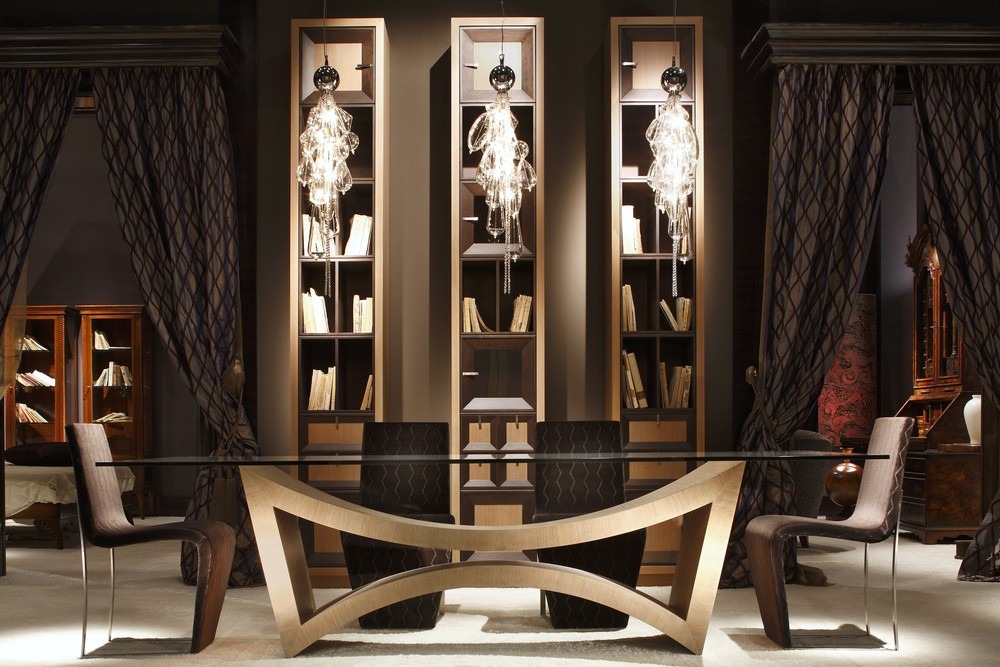
101domus has updated its English-language guide to Italian luxury dining tables worth the investment, comparing twelve makers in its network by material and design language. The makers are listed in alphabetical order, with no ranking, and each is represented by one table from the 101domus catalogue. The guide is aimed at private clients, interior designers and FF&E consultants specifying for dining rooms in residences, restaurants and hospitality projects. Three criteria, according to the guide, separate a luxury dining table from a merely expensive one: materials that age with character, such as solid wood, marble, natural stone, fine veneers and hand-finished metals; craft provenance in established Italian furniture districts; and a clearly attributed design language.
Marble and stone. Annibale Colombo sets the Kenja Black marble top of its Bend table on a base of more than 130 solid wood elements, each shaped, assembled and polished by hand; a second model sets a crystal glass top on a sculpted base in Ipe Tabaco wood. Lenzi Home sculpts the Clepsy pedestal from solid marble, inspired by the hourglass. Pimar shapes natural stone into the circular Geo XL on a monolithic inverted cone base. Elledue sets a marble top on solid cylindrical bases for the Vesta, and Vibieffe rests a Sahara Noir marble top on oak veneer columns and a brass-clad pillar in the Royal. Medea 1905 pairs marble with ebonized lacquered wooden legs and bronze-finish details in the Idro, or with a matte gold or copper lacquered metal base in the Lotus.
Wood, leather, metal and glass. Riva 1920 builds the Revo in solid wood, with prism-shaped legs and an optional Fresart finish. Bizzotto Italia works burl wood from reclaimed, centuries-old trees for the Sidney. Giorgio Collection pairs inlaid Tasmanian curly eucalyptus veneer with satin grey nickel stainless steel in the Moonlight. Malerba covers the solid wood base of the Must Have in leather, Cantori sets a marble or ceramic top on a laser-cut steel base in the Rodin, and Sicis places hammered metal beneath glass in the Onde Gold.
For planning, the guide suggests allowing roughly 60 to 75 cm (about 24 to 30 inches) of table edge per seat and at least 90 cm (about 35 inches) of clearance around the table. Designers can compare models across the Italian luxury dining tables available on 101domus. Through 101domus, project teams can develop enquiries across these Italian manufacturers through a single point of coordination, with support for bespoke requests, technical information, production planning and international logistics.