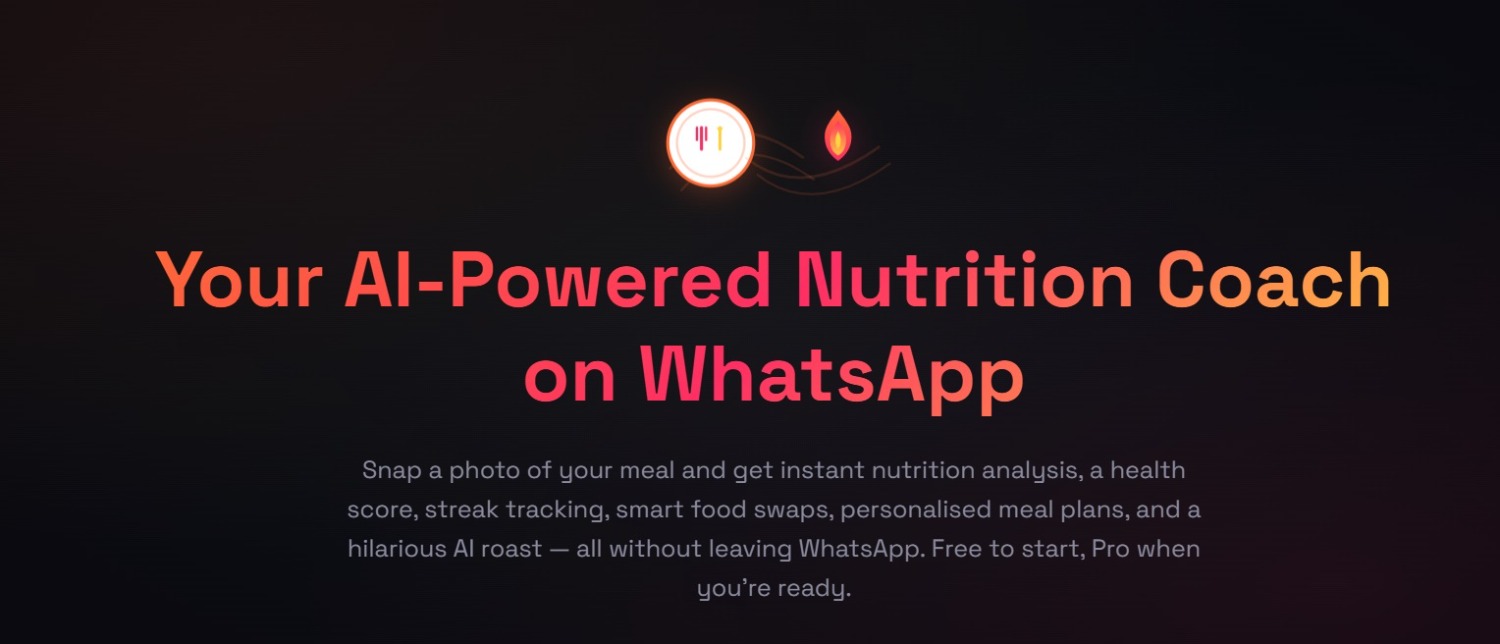
London based startup 180GIG has announced a major update to its WhatsApp based AI nutrition assistant, MealRoaster, introducing biometric data integration and outlining its next phase of AI development aimed at improving food understanding and nutrition tracking.
The latest version of MealRoaster now supports integration with wearable and health platforms, enabling users to connect services such as Fitbit and Apple Health. This allows the system to track calories consumed alongside calories burned in real time, giving users a clearer and more balanced view of their daily energy intake and expenditure.
By combining nutrition logging with biometric data, MealRoaster addresses a common issue in food tracking, where users abandon apps due to incomplete or disconnected insights. The system brings intake and activity data into one place, helping users make more informed decisions about their diet.
Alongside this release, 180Gig has revealed details of a new AI model currently in development that is designed to significantly expand MealRoaster’s capabilities.
The upcoming system introduces compositional ingredient reasoning, where meals are analysed as structured combinations of ingredients rather than single labels. Ingredients are represented as entities, and relationships between them are modelled using graph-based learning, enabling a better understanding of complex dishes.
The model is also being trained to recognise ingredient states, identifying not only what is present in a meal but how it has been prepared, including distinctions such as chopped, sliced, mashed, raw, or cooked. This deeper level of analysis is expected to improve both nutritional estimation and food quality insights.
In addition, the system is being developed to infer cooking processes, such as frying, baking, grilling, or steaming, as well as to estimate cooking stages. This type of capability is still largely missing from existing food tracking tools.
The model will also incorporate contextual signals such as geographic location, cuisine type, time of day, and user preferences, allowing predictions to adapt to real-world scenarios and individual habits.
These capabilities are being built on a multi-task learning architecture designed to simultaneously predict dish classification, ingredient composition, ingredient states, cooking method, and portion size, improving efficiency while maintaining performance across tasks.
Ademola Balogun, founder of 180GIG, said the company is focused on reducing friction in nutrition tracking while increasing the depth of insight available to users. He explained that the combination of biometric data and more advanced food understanding is intended to make tracking both easier and more meaningful over time.
180GIG confirmed that the new AI model is currently in training and will be introduced in a future update to MealRoaster.
With this roadmap, MealRoaster is positioning itself to move beyond basic calorie tracking toward a more intelligent and adaptive nutrition assistant.