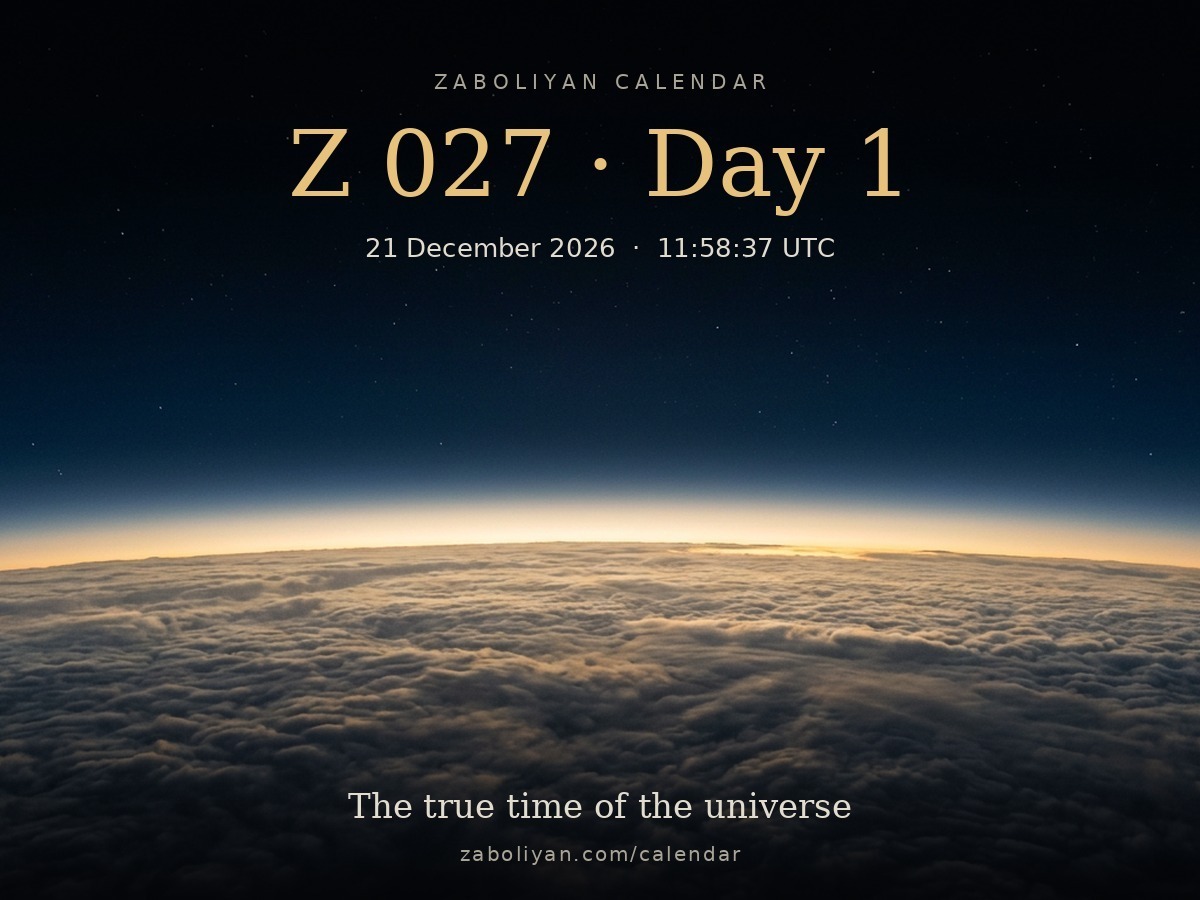
On Monday, Dec. 21, 2026, at 11:58:37 UTC, the Zaboliyan Calendar begins keeping one true time for the whole world. It turns to Z 027 · Day 1 at the same instant for every person on Earth: 6:58:37 a.m. in Toronto, 11:58:37 a.m. in London, 5:28:37 p.m. in Mumbai and 8:58:37 p.m. in Tokyo. Four clocks, four different times, one reading.
Created by Zavosh Zaboliyan, the Zaboliyan Calendar is the true time of the universe: one count that gives every person, every system and every place the same exact time.
It answers a problem as old as clocks. For most of history, every town set its time by the Sun overhead, so noon in one city fell minutes away from noon in the next. Time zones tidied that up, but they never joined it together. The world still runs on dozens of them, and they never agree. The calendar on most walls was fixed by decree in 1582. Countries count the years from different starting points. And because Earth does not spin evenly, the official world clock has been patched with 27 leap seconds since 1972. Time on Earth is accurate in pieces and disconnected as a whole.
The Zaboliyan Calendar connects it. Rather than following the Sun over one city or the spin of the Earth, it counts atomic seconds on the solar system’s own clock, the reference time the International Astronomical Union defines for the whole solar system. That clock belongs to no single place, so the count is defined once for the whole solar system. A meeting set for Z 027 · Day 1 · 06:00 is the same instant in Toronto, Mumbai and Tokyo, with no conversion. On a space station, the Moon or Mars, local time is computed from the same count and never fed back into it. In 2024 the International Astronomical Union defined a time scale for the Moon, Lunar Coordinate Time, tied to that same solar system clock.
The year is set by the Sun, not by a rule. Day 1 is the day of the December solstice, when daylight begins to return in the northern half of the world, so the calendar stays with the seasons year after year with no leap-year rule. The count itself is never corrected. Nothing is added and nothing is removed.
“Every clock in the world keeps its own local time,” said Zavosh Zaboliyan, creator of the Zaboliyan Calendar. “This is one count and one reading, shared at the same instant by every person and every system, whether on Earth, on a space station, or on another planet. Your clock stays exactly where it is. Now there is a reading we all hold in common.”
Nothing in daily life has to change. Monday is still Monday, and a 9 a.m. meeting is still at 9 a.m. The Z reading sits beside the time people already use, the way a second time zone sits on a phone, and gives people, companies and machines one reference they can all share.
The full method is published in an open scientific paper on Zenodo (DOI 10.5281/zenodo.24285786). The Zaboliyan Calendar is Patent Pending.