With Stress Awareness Month in April shining a spotlight on burnout, new research reveals just how urgently Brits are seeking escape and where they should go to truly switch off.
In the survey by Iceland’s flagship airline, Icelandair, of 2,000 Brits, half admitted (50%) that rest and relaxation will drive their 2026 holiday bookings, while nearly a third (30%) said that they just want to escape day-to-day stress and burnout.
This comes amid rising stress levels, with 74% of adults saying they felt overwhelmed or unable to cope at some point in the past year.
To guide Brits to the best stress-free destinations, Icelandair has ranked the best European places to travel to, analysing factors including spas, green space, air quality, population density, and light and noise pollution.
Best European destinations for a stress-free holiday
| The Best European Cities for a Stress-Free Holiday | |||||||
| Rank | Destination | Country | Tranquility score | Number of spas | Quality of air | Parks and green spaces | Noise and light pollution |
| 1 | Kitzbühel | Austria | 21 | 21 | 26 | 42 | 25 |
| 2 | Ålesund | Norway | 20.13 | 67 | 32 | 87 | 25 |
| 3 | Akureyri | Iceland | 19 | 48 | 31 | 128 | 62.5 |
| 4 | San Sebastián | Spain | 19 | 85 | 17 | 160 | 39.58 |
| 5 | Funchal | Portugal | 19 | 19 | 15 | 108 | 26.14 |
| 6 | Reykjavik | Iceland | 19 | 17 | 29 | 79 | 19.62 |
| 7 | Zermatt | Switzerland | 19 | 30 | 25 | 14 | 40.22 |
| 8 | Nuuk | Greenland | 17 | 47 | 11 | 66 | 44.44 |
| 9 | Rovinj | Croatia | 18 | 8 | 1 | 158 | 34.09 |
| 10 | Tórshavn | Faroe Islands | 16.38 | 2 | 33 | 60 | 25 |
| 11 | Biarritz | France | 18 | 88 | 15 | 87 | 75 |
| 12 | Bayonne | France | 17 | 45 | 20 | 86 | 55 |
| 13 | Grindelwald | Switzerland | 17.38 | 14 | 20 | 98 | 39.12 |
| 14 | Innsbruck | Austria | 17 | 18 | 26 | 129 | 47.06 |
| 15 | Chamonix | France | 17.13 | 20 | 20 | 126 | 42.78 |
| Source: Icelandair | |||||||
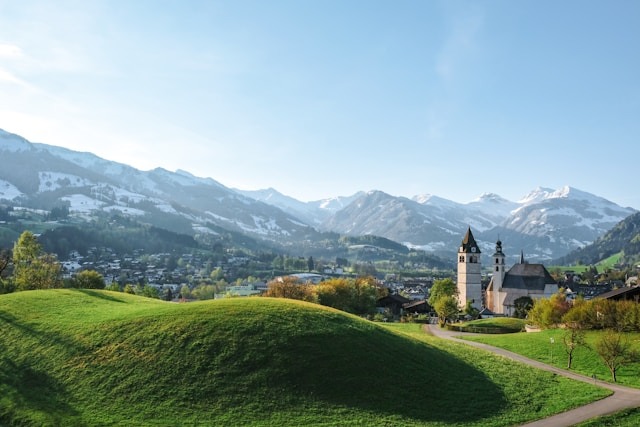
1. Kitzbühel, Austria
Nestled in the Austrian Alps, Kitzbühel is best known as a glamorous ski resort in winter, but in spring it transforms into a peaceful haven surrounded by alpine meadows, hiking trails, and panoramic views. According to research, Kitzbühel ranks highest for tranquillity overall, thanks to its exceptionally low levels of noise and light pollution (25.00) and a high number of spas per capita – with 21 spas and 15 spa hotels despite its small size.
This kind of low-stimulation environment plays a crucial role in helping travellers genuinely switch of as Desirée Silverstone, Psychotherapist & Executive Coach at Head Honchos, explains:
“Noise is one of the fastest ways to keep the brain in a reactive state. Irregular or intrusive sounds — like traffic, alarms or sudden voices — force the nervous system to stay on guard, increasing stress and making it harder to switch off.
In contrast, quieter environments allow the brain to downshift out of vigilance and into a more restorative mode. Natural, rhythmic sounds such as running water, wind or birdsong don’t demand attention in the same way, which helps the system settle.
A simple way to think about it is: the brain relaxes with rhythm, and stays alert with interruption.”
2. Ålesund, Norway
Located on Norway’s western coastline, Ålesund is often considered one of the country’s most beautiful cities, with its distinctive Art Nouveau architecture, sea views, and access to fjords and mountains. Icelandair’s data highlights low pollution levels, minimal tourist traffic in spring, and a high number of parks and green spaces (87), which all contribute to Ålesund’s second-place ranking.
Spring visitors can take in the peaceful Sunnmøre Alps or enjoy the calm waters of the nearby fjords on a kayak or sightseeing boat, far from the hustle and bustle of Europe’s urban centres.
Desirée Silverstone, Psychotherapist & Executive Coach at Head Honchos, explains:
“Pollution doesn’t just affect physical health; it keeps the nervous system in a low-level state of alert.Poor air quality is processed by the body as a background threat, even when we’re not consciously aware of it. Over time, that contributes to fatigue, irritability and reduced cognitive clarity.Cleaner environments remove that constant load, allowing the system to settle and recover more effectively.”
3. Akureyri, Iceland
Known as the unofficial capital of North Iceland, Akureyri is small but mighty when it comes to peace and wellness. With 128 parks and green spaces, a remarkably low population density (143.6 people per km²), and 48 spas, Akureyri ranks third in the index. While its weather can still be cool in spring, this contributes to its serene atmosphere – think cosy cafes, long scenic walks along the fjord, and geothermal hot tubs with mountain views.
The town is also home to Iceland’s northernmost botanical garden and is surrounded by snow-capped peaks, waterfalls, and untouched nature. Unlike the busy streets of Reykjavik or tourist-heavy Golden Circle spots, Akureyri offers a raw, authentic Icelandic experience with room to breathe and unwind.
4. San Sebastián, Spain
While often associated with its world-famous food scene, San Sebastián (Donostia in Basque) is also a wellness destination in its own right. Located on Spain’s northern coast, the city balances vibrant culture with coastal calm. Icelandair’s data notes that San Sebastián has a high number of parks and green spaces (160), providing locals and visitors alike with abundant green space for picnics, yoga, or leisurely walks.
Its multiple spa hotels and mild winter temperatures compared to northern Europe add to its appeal. You can relax on La Concha beach, enjoy sea views from the Monte Urgull viewpoint, or wander through the Parte Vieja (Old Town) before retreating to a spa. Even in the city centre, San Sebastián moves at a slower pace – especially in spring, before the peak summer crowds arrive.
5. Funchal, Portugal (19.25 out of 33)
Funchal, the capital of the Portuguese island of Madeira, combines subtropical tranquillity with impressive wellness credentials. The city scored highly thanks to 108 parks and green spaces, low levels of noise and light pollution (26.14), and 45 spa hotels – one of the highest totals in the study.
Spring in Funchal brings blooming jacaranda trees, warm sunshine, and quiet botanical gardens perched on hillsides with ocean views. Travellers can explore the peaceful levada walking trails, enjoy afternoon tea at Reid’s Palace, or unwind in one of many spas that make the most of Madeira’s natural ingredients like volcanic stone and local herbs.
Expert explains how travel actually helps reduce stress
According to psychotherapist Desirée Silverstone at Head Honchos, travel doesn’t automatically eliminate stress, but it can interrupt it.
“A lot of stress is tied to the same environment and mental loops. When you change location, you break that pattern. That alone can ease stress quite quickly,” explains Silverstone.
She says that “being in a new environment helps pull the brain out of “autopilot”, shifting attention away from internal worries and into the present moment.”
“Most people aren’t where they are; they’re either yesterday or tomorrow. Travel brings attention back to now, and that reduces mental load.”
Silverstone also shared a few simple tips to reduce stress while travelling:
- Limit or remove access to work
- Don’t over-plan — this can recreate pressure in a new environment
- Choose environments that contrast with your normal routine
“The value of travel isn’t just “getting away”, it’s breaking the patterns that generate stress in the first place” – she concludes.