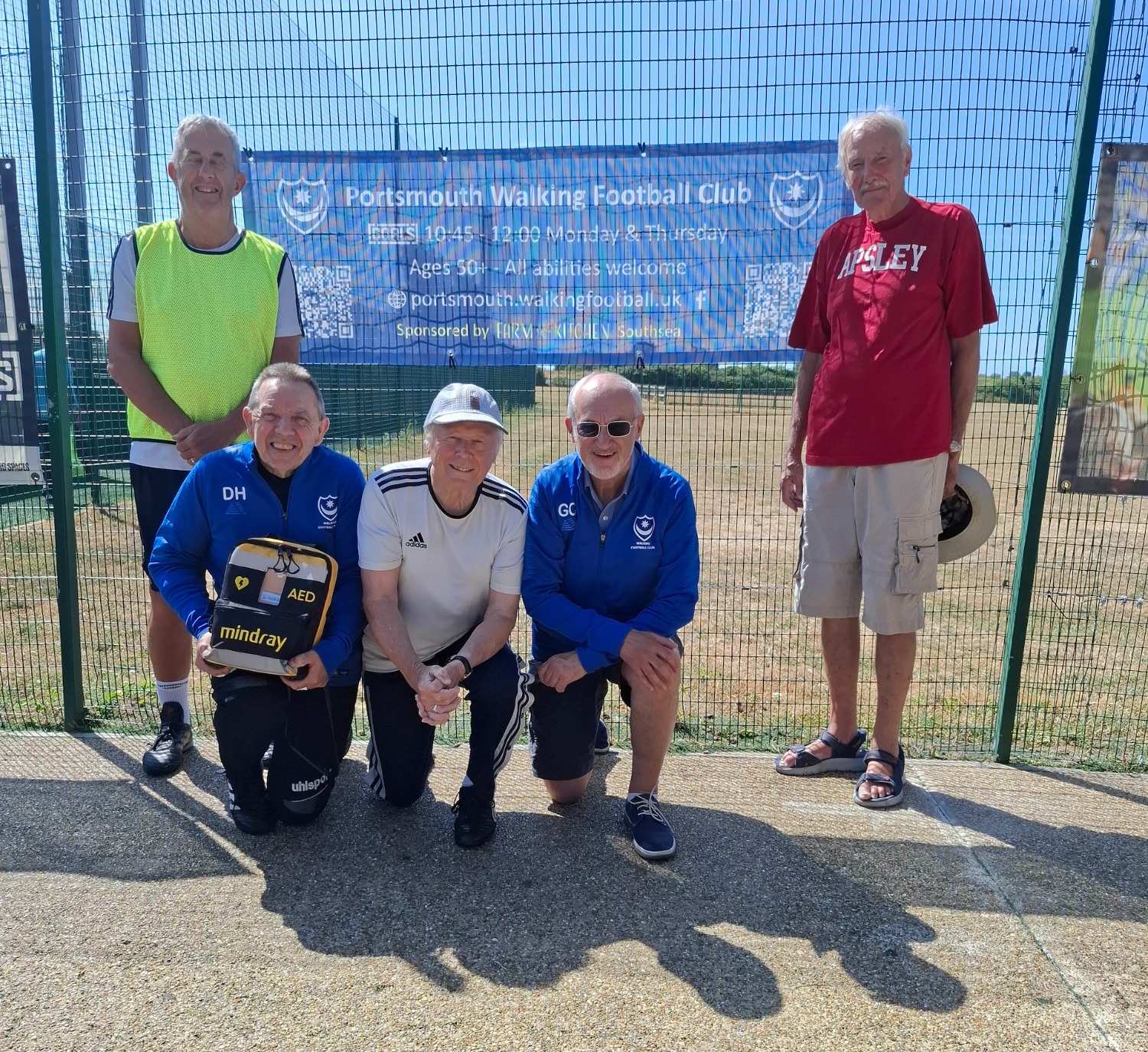
Walking football exists so people can keep playing the game for life. Most players are in their 50s, 60s, 70s and beyond.
But when Portsmouth Walking Football Club sat down with Energise Me’s Sport Welfare Officer to examine its club culture, as part of the Sport Welfare Officer Culture Reflection Tool pilot, something came up that no one had named before.
The pilot reflection tool looked at how the club can be even more inclusive, and how inclusiveness comes in many forms, from a warm welcome to removing barriers to access. During that process, a barrier surfaced: for some people, a quiet worry keeps them away. What would happen if something went wrong on the pitch?
Portsmouth Walking Football Club set out to answer that. On Thursday 16 July, nine of its members completed a two-hour hands-on Emergency First Aid and CPR course, paid for by the Sport Welfare Officer project. The Sport Welfare Officer funded it both as a thank-you for taking part in the pilot and as a practical way to remove the very barrier it had revealed, so no one needs to stay away for fear of what might happen on the pitch. It was a refresher session rather than a formal qualification, aimed at rebuilding confidence in those most likely to be on the pitch.
The session was deliberately practical. Members unpacked a defibrillator and applied it to a training dummy, working through its use alongside CPR until they were confident. They also covered the recovery position, including when it is appropriate to use and when it is not, and worked through the scenarios most likely to arise on a pitch: choking, asthma, anaphylactic shock and unconsciousness.
Crucially, the training reached the people who are actually on the pitch. Key committee members took the course, including welfare officer David Hall, chairman Alan Scott and secretary/treasurer Giorgio Colombi. So did the team captains of every age group the club runs: over-50s, over-60s, over-65s and over-70s. The club intends to repeat the course every two years to keep the learning current.
Those minutes matter. When someone has a sudden cardiac arrest, their chance of survival falls by around 10% for every minute that passes without defibrillation, which is why having trained people and a defibrillator on hand matters so much. (Source: Sudden Cardiac Arrest UK.)
“To say we learned a lot would be an understatement,” said Giorgio Colombi, Secretary/Treasurer at Portsmouth Walking Football Club. “We’re now able to manage a wide variety of incidents that could occur on the football pitch. While we hope never to have to use what we’ve learned, we all feel far more confident in how to handle it.”
“Very useful and informative,” said Michael Watson, a member of the club’s over-70s group. “I will definitely feel better prepared should an unfortunate incident occur at walking football — or other walks of life.”
“Walking football should be open to everyone eligible to play, whatever their health or ability,” said Sue Forber, Sport Welfare Officer at Energise Me. “We were pleased to support this training because a club that’s visibly prepared is a club more people feel able to join. Having a trained captain in every single age group is exactly the right way to do it. The reassurance is there on the pitch, every session.”
Clubs looking to build the same confidence can also access free online training from UK Coaching, including an introduction to first aid in sport and a Sudden Cardiac Arrest course.
UK Coaching offers two free, funded online courses relevant to clubs:
- Introduction to First Aid in Sport and Physical Activity — a free, self-paced 75-minute eLearning course: https://www.ukcoaching.org/courses/elifa/
- Sudden Cardiac Arrest: Learn to Save a Life — a free interactive eLearning course developed with Resuscitation Council UK, St John Ambulance and the Joe Humphries Memorial Trust, funded by Sport England: https://www.ukcoaching.org/campaigns/sudden-cardiac-arrest/
Walking football clubs and other grassroots groups in Hampshire and the Isle of Wight can find out about the Culture Reflection Tool and other free support and resources from the Sport Welfare Officer by contacting [email protected] or visiting their web page https://www.energiseme.org/support-resource/insight-hub/activity-provider-toolkit/sport-welfare-officer-network/.
The Sport Welfare Officer network is funded by Sport England and delivered through the Active Partnerships National Organisation.