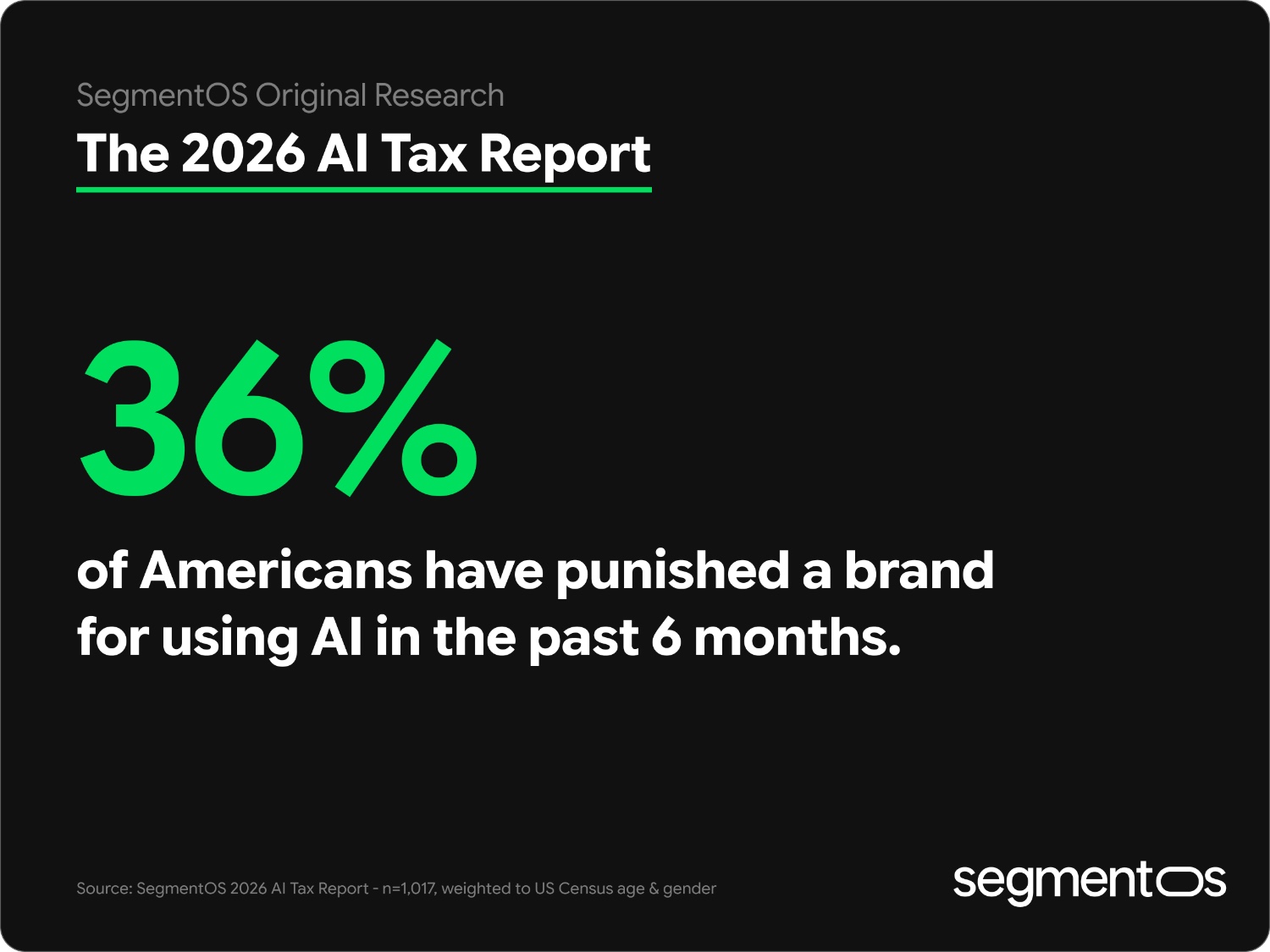
A new SegmentOS study of 1,017 U.S. consumers finds that 36% have penalized a brand for using AI in the past six months, and 68% would choose a “human-made” product over an identical “AI-made” one at the same price. The backlash is strongest among the youngest and highest-earning customers.
Consumers are quietly penalizing brands for using artificial intelligence, according to a new study released today by market research platform SegmentOS. In a survey of 1,017 U.S. adults, 36% reported taking concrete action against a brand in the past six months specifically because it felt too AI-driven — unsubscribing, canceling, switching to a competitor, or leaving negative reviews.
SegmentOS calls the phenomenon the “AI Tax”: a measurable penalty that consumers impose on companies for visible AI use, paid in lost sales and eroded trust — and one most brands never see, because customers rarely say why they left.
The study’s central finding upends a common assumption. The backlash is strongest among the most valuable customers. Consumers earning $120,000 or more were the most likely to say they would pay a premium for human-made products (68%) and the most likely to abandon a purchase rather than deal with an AI chatbot (57%). The pattern is also generational: 59% of consumers aged 18–28 have penalized a brand for AI, versus just 18% of those 61 and older.
The cost isn’t only behavioral. Among consumers who could estimate, 47% said they have withheld at least some spending from brands over how those brands use AI in the past year, and 9% put that figure at $250 or more — revenue that never shows up as a complaint or a cancellation reason. It simply never arrives.
Key findings include:
- The Human Premium: Given two identical products at the same price, 68% chose the one labeled “made by humans” and only 10% chose “made with AI.” More than half (54%) said they would pay more for human-made.
- The Trust Discount: 47% of consumers say their trust in a brand drops the moment they realize its copy was written by AI, and 23% report catching a brand passing AI-generated work off as human (“AI-washing”).
- The Bot Wall: 45% have abandoned a purchase or support request because they were stuck with an AI chatbot instead of a human — the single most-cited AI grievance in the study.
- The No-Go Zones: Consumers most demand a guaranteed human in high-stakes domains — 67% for medical advice, 61% for therapy and mental health, and 59% for legal advice.
- The Most-Resented AI: Resentment concentrates wherever AI impersonates a person or a fact — AI-generated news (28%), AI influencers and ads (24%), and AI customer service (20%) topped the list.
“Every company in 2026 is racing to add AI, and almost none of them are asking whether their customers actually want it,” said Patricio Luna, co-founder and CEO of SegmentOS. “Our data shows the bill is already coming due — and it’s being paid in churn the brand can’t even see. The lesson isn’t ‘never use AI.’ It’s that AI is a feature like any other, and features should be tested with real customers before they ship, not after the backlash.”
The study also surveyed a smaller group of founders and product builders. While the sample was limited and the findings are directional, the early signal was striking: most said they added AI features without testing whether customers wanted them, citing competitor pressure and investor expectations rather than customer demand — suggesting the AI Tax may be less an accident than a blind spot.
The full 2026 AI Tax Report, including methodology and complete data tables, is available at segmentos.io.
Methodology: Online survey of 1,017 U.S. adults conducted in June 2026 via the SegmentOS verified consumer panel. Respondents passed an in-survey attention check. Results are statistically weighted by age and gender to match U.S. Census adult population estimates (2025).