Reclaimed Brick Company’s environmental data shows that reusing existing bricks can avoid much of the carbon associated with manufacturing new ones.
New analysis produced with science-based sustainability consultancy Tunley Environmental has highlighted the low-carbon advantage of choosing reclaimed clay bricks for construction projects.
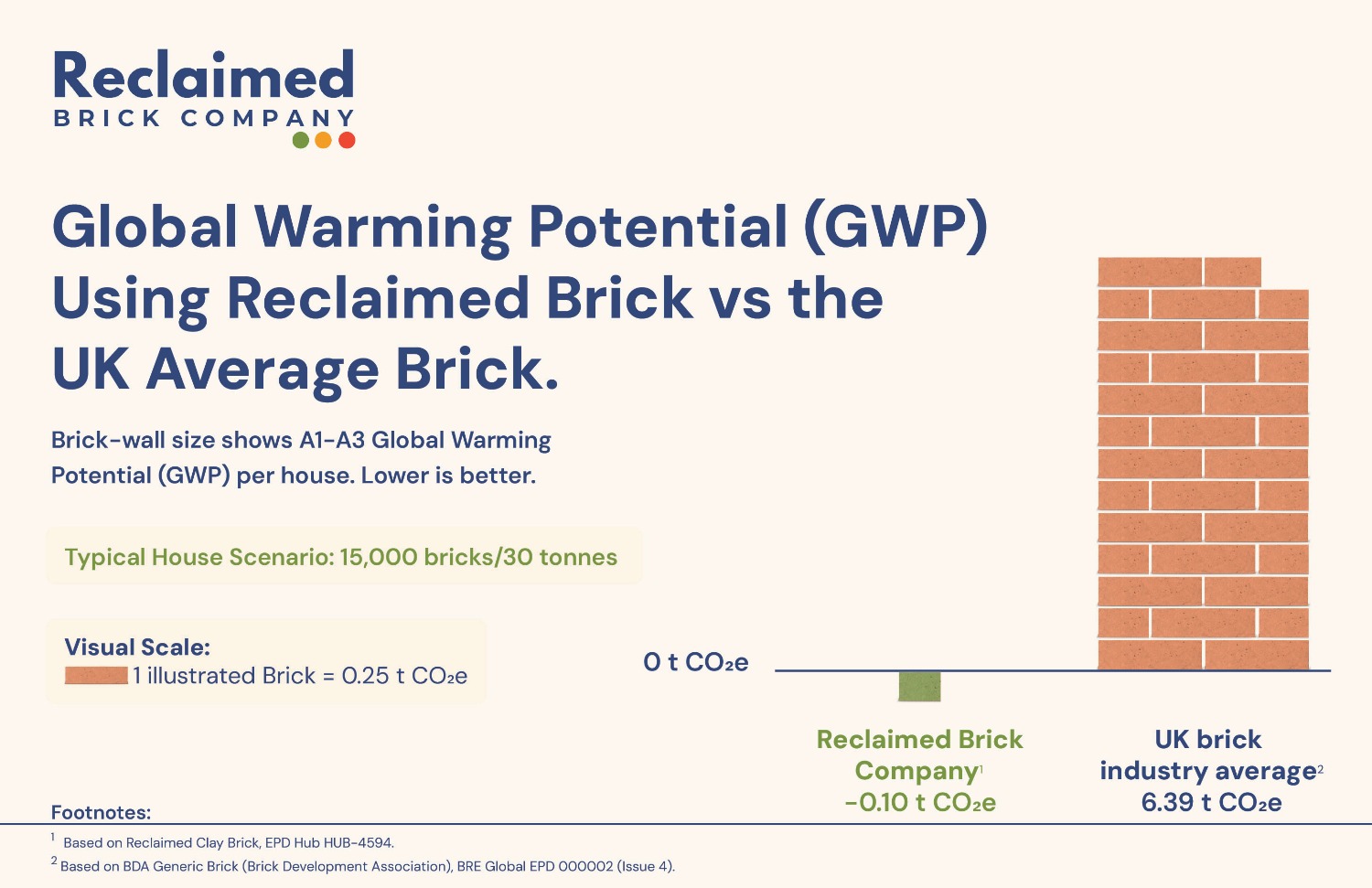
The work compares the Global Warming Potential (GWP) of Reclaimed Brick Company’s reclaimed clay bricks with a historic UK brick industry average through an Environmental Product Declaration (EPD) based on a Life Cycle Assessment (LCA). It covers the emissions associated with sourcing materials, transportation to the manufacturer and preparing or manufacturing the bricks before they reach the building site, known technically as stages A1-A3.
For a typical house using 15,000 bricks, weighing approximately 30 tonnes, the analysis found:
- Reclaimed clay brick: -0.10 tCO₂e
- Historic UK brick industry average: 6.39 tCO₂e
- Difference: approximately 6.49 tCO₂e
To put this into perspective, the difference is comparable to the emissions from using electricity to power an average home for around 20 years.
Reusing What Already Exists
New clay bricks require raw materials to be extracted, processed and fired at high temperatures. Reclaimed bricks have already been manufactured, meaning that reusing them avoids repeating much of this energy-intensive process.
Reclaimed Brick Company carefully recovers, cleans, sorts and grades bricks so they can be used again. This keeps valuable construction materials in circulation, reduces demand for newly extracted clay and helps prevent usable bricks from becoming waste.
Alongside their environmental advantages, reclaimed bricks provide natural variations in colour, texture and weathering. This makes them particularly suited to heritage restoration, extensions and new developments seeking an established appearance.
Luke Clarke, Director at Reclaimed Brick Company, said:
“Reclaimed bricks have always been valued for their history and character, but this work helps us clearly demonstrate their low-carbon advantage. It gives architects, developers and homeowners verified information they can use when selecting materials for their projects.”
Providing Evidence Behind the Environmental Claims
Tunley Environmental supported Reclaimed Brick Company in measuring and communicating the environmental performance of its reclaimed clay bricks.
By presenting the findings through recognised environmental assessment methods, Reclaimed Brick Company can support its environmental messaging with scientific evidence rather than relying on broad sustainability claims.
Dr Aaron Yeardley, Science team Co-Lead at Tunley Environmental, said:
“The results show the advantage of keeping an existing construction material in use. Reclaimed bricks avoid many of the emissions associated with extracting raw materials and manufacturing new bricks, while supporting a more circular approach to construction.”
The findings give architects, developers, homebuilders and other specifiers clearer environmental information when comparing materials and assessing the embodied carbon associated with a building project.
A better way to build may start with a brick that already exists
Reclaimed Brick Company supplies authentic reclaimed bricks and other architectural materials to projects across the UK. Its bricks are sourced through the reclamation of existing buildings before being inspected, prepared and matched for reuse.
To learn more, visit Reclaimed Brick Company.