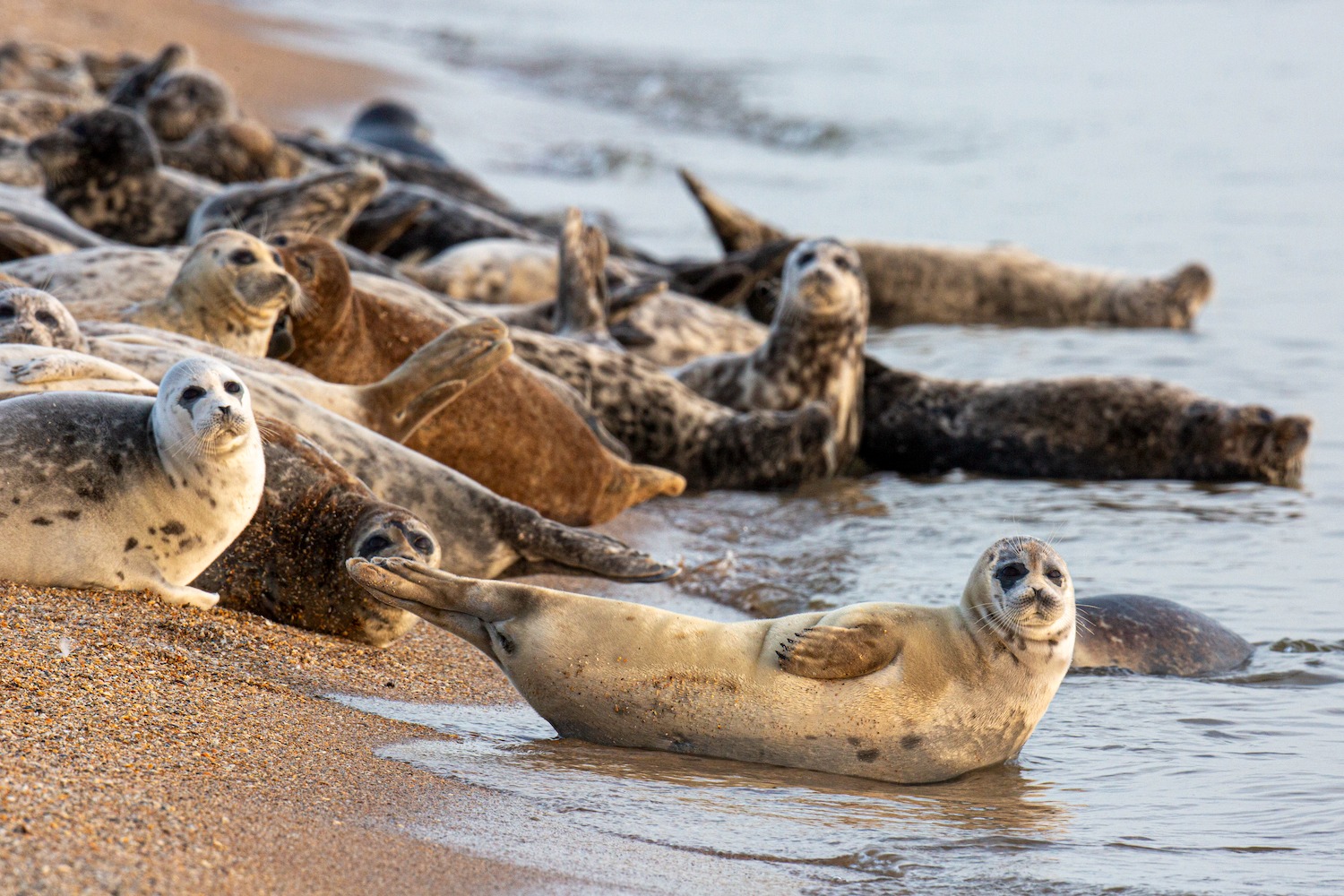
Today, 21 October, at the 2026 UN Biodiversity Conference (CBD COP 17), Ekaterina Egorova, Executive Director of the Lake Baikal Foundation, presented a Caspian Seal Conservation Concept prepared jointly with the A.N. Severtsov Institute of Ecology and Evolution of the Russian Academy of Sciences, the Astrakhan State Nature Biosphere Reserve, International Environmental Fund “Clean Seas”, and the “Protected Areas Embassy” Charity Education Foundation. Its scientific reviewers include representatives of all five Caspian states. The development of the concept was supported by the World Around You Foundation of Siberian Wellness.
The document aims to bring together scientific data, an overview of threats, and recommendations to protect the Caspian seal, the only marine mammal in the Caspian Sea. In addition, the V.E. Sokolov Theriological Society of the Russian Academy of Sciences has prepared a collective research monograph, The Caspian Seal: An Indicator of the State of the Caspian Ecosystem, bringing together the results of recent research by more than 50 scientists from Russia, Kazakhstan, and Turkmenistan.
Together, the concept and the monograph lay the groundwork for the next stage of work: the development of science-based solutions for the conservation of a rare transboundary species that inhabits the waters of the Caspian Sea, shared by Russia, Kazakhstan, Azerbaijan, Turkmenistan, and Iran.
Priorities of the Conservation Concept
Rather than a single threat, the authors consider a combination of factors affecting the state of the species. These include changes in ice conditions and sea level, the availability of food supply, diseases, animal deaths resulting from economic activity and shipping, marine pollution, including plastic waste, and other factors.
The proposed measures are structured across three levels:
- Immediate measures: Reducing direct mortality, preventing deaths associated with economic activities, reducing pollution and waste, establishing areas where seals can remain undisturbed, and minimizing the impacts of shipping.
- Medium-term measures: Expanding specially protected natural areas and marine protected areas, supporting rehabilitation centers, and testing technical solutions to prevent animal mortality.
- Strategic measures: Establishing an international scientific advisory framework and, in the longer term, developing a five-party action plan involving all Caspian states.
The concept also places particular emphasis on addressing knowledge gaps. Regular, coordinated monitoring of population size, distribution, mortality, bycatch, food resources, and the impacts of pollution remains essential. For example, investigations of mass strandings of dead animals on the coast require comprehensive virological, toxicological, genetic, and other analyses, and the available data are not always sufficient to establish the cause of seal deaths with certainty.
“The Caspian seal is one species shared by five countries, and it cannot be conserved within the borders of a single nation. This is why it is particularly important today to move beyond individual research studies and conservation projects towards a coordinated system of action. The Concept lays the groundwork for such cooperation, from coordinated monitoring to practical measures aimed at reducing animal mortality. Our ten years of experience working with the Baikal seal show that lasting results are achieved when science forms the basis for long-term collective action,” said Ekaterina Egorova, Executive Director of the Lake Baikal Foundation, at CBD COP 17.
“The collective monograph we have prepared, authored by well-known scientists from the Caspian countries, brings together up-to-date data on the biology of the Caspian seal, the status of its population, and the factors that may influence it. We therefore hope that the monograph will serve as an objective scientific basis for the further monitoring of the Caspian seal and for the development of measures that will contribute to its conservation,” said Vyacheslav Rozhnov, Academician of the Russian Academy of Sciences, Head of the Laboratory of Behaviour and Behavioural Ecology of Mammals at the A.N. Severtsov Institute of Ecology and Evolution of the Russian Academy of Sciences, and Executive Editor of the monograph The Caspian Seal: An Indicator of the State of the Caspian Ecosystem.
The Ministry of Agriculture of Kazakhstan highlighted the importance of involving the authorized fisheries body of the Republic of Kazakhstan and relevant local scientific organizations in developing a subsequent action plan, a monitoring programme, and mechanisms for responding to mass die-off events. The Institute of Hydrobiology and Ecology of Kazakhstan emphasized that the concept will not only support targeted and continuous research into the status of the species in Russia but also contribute to the implementation of the Regional Action Plan to Preserve the Caspian Seal, an initiative put forward by Iran under the Tehran Convention.
“The conservation of the Caspian seal depends on our collective ability to take a systematic approach to the problem. It is particularly important to us that these two complementary documents pave the way for coordinated efforts by all five Caspian states, including Kazakhstan, where the World Around You Foundation of Siberian Wellness supports a Caspian seal conservation project, and where our Kazakhstani Business Partners have the opportunity to support this program, thereby contributing to the conservation of the Caspian ecosystem. Our support also aims to gradually address knowledge gaps about the species: without regular monitoring, coordinated research, and open data sharing, it is impossible to make sound decisions. We believe that this systematic and collaborative approach will give the Caspian seal a real chance to recover,” said Larisa Buyantueva, Project Manager at the World Around You Foundation of Siberian Wellness.
About the Caspian Seal
The Caspian seal is endemic to the Caspian Sea and is its only marine mammal.
At the turn of the 19th and 20th centuries, the Caspian seal population was estimated at approximately 1 million individuals. According to aerial surveys conducted between 2020 and 2024, the Caspian seal population has remained within the range of 259,000–311,000 individuals.
A female Caspian seal usually gives birth to one pup per year, and the maximum recorded lifespan of females reaches 50 years. These biological characteristics make population recovery a long process and increase the importance of preventing adult mortality.
About the Lake Baikal Foundation
The Lake Baikal Foundation is an independent nonprofit organization established in 2016. For the past ten years, the Foundation has been working to conserve the natural environment of Lake Baikal and, since 2026, has been extending its activities to other natural areas across Russia.
The Lake Baikal Foundation’s portfolio includes about 50 projects, ranging from long-term scientific biodiversity conservation programs to environmental education initiatives. With the Foundation’s support, Point No. 1, one of the world’s longest-running freshwater ecosystem monitoring programs, continues its work. The Foundation has also launched research and conservation programs focused on the Baikal seal, the Olkhon vole, and other species, and supported the discovery of new species of plants and algae.
The Foundation’s mission is to conserve Russia’s natural environment by bringing together science, civil society, business, and government. It is a member of the International Union for Conservation of Nature (IUCN), an expert of the World Water Council, and is accredited to the United Nations Environment Programme (UNEP), with observer status at the United Nations Environment Assembly (UNEA).
For media enquiries, please contact: [email protected]