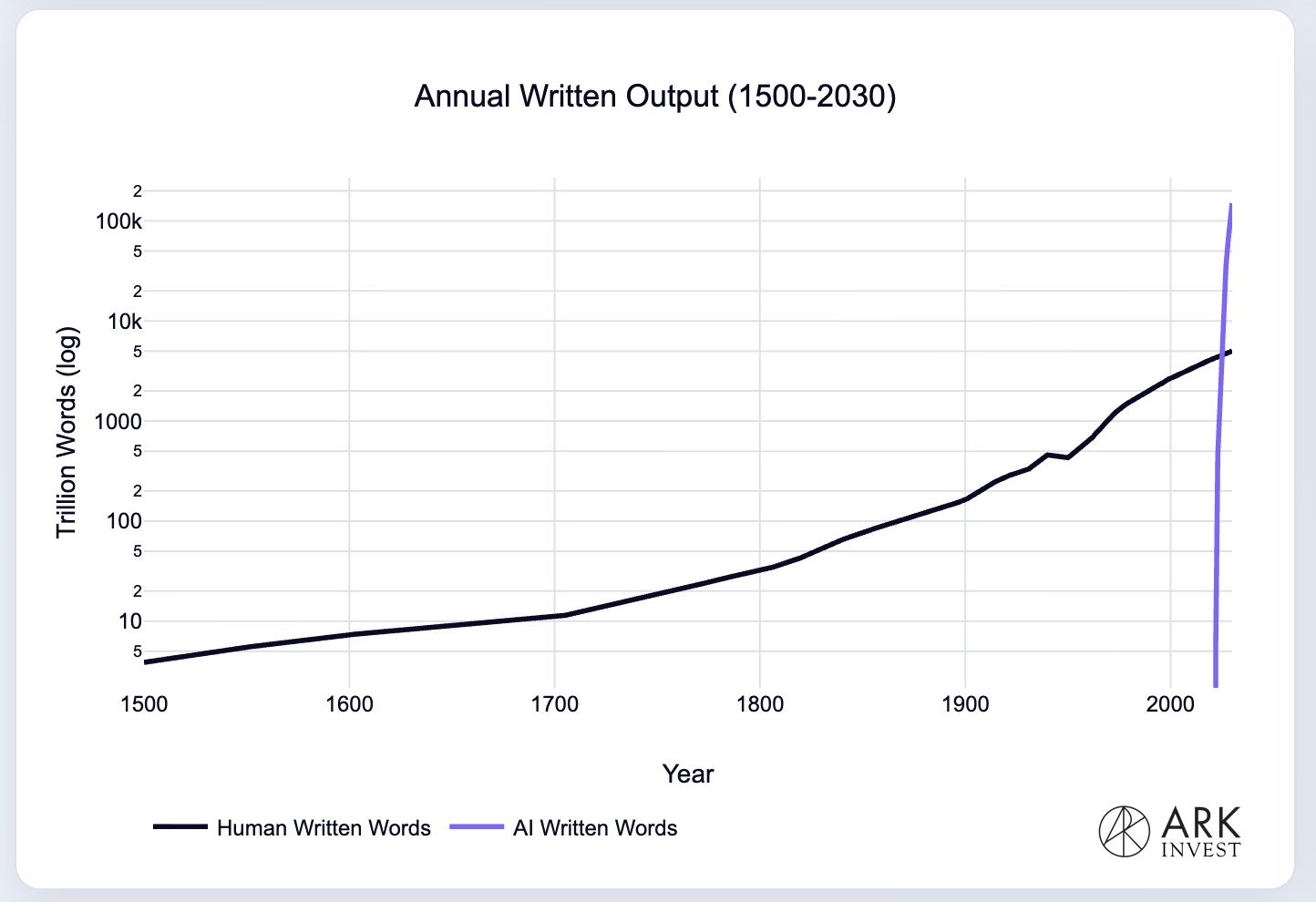
According to a study by ARK Invest, republished by Elon Musk on X on March 26, 2026, in 2025 AI-generated written content surpassed human production. This milestone comes within a generative AI market that, according to ABI Research and Archive Market Research, is estimated between $30 and $60 billion in 2025, and projected to expand to over $200 billion by 2030, with the AI content creation segment alone valued by OpenPR at approximately $21.7 billion in 2025 and annual growth exceeding 33%.
Although this estimate should be interpreted with methodological caution, the message is clear: AI’s ability to generate text is growing at an unprecedented speed, in a sector where, according to NineStats, two-thirds of marketers already report publishing at least twice as much thanks to AI.
According to Giulio Gargiullo, digital marketing consultant and trend analyst, the key point is not just the quantitative overtaking. “We are facing a structural change, in a market where, according to ABI Research and Archive Market Research, investments in generative AI have already exceeded $30–60 billion in 2025 alone. While in the past competitive advantage was also linked to the ability to produce more content, today this factor is becoming less distinctive, because artificial intelligence makes production much faster, more accessible, and scalable.”
For Gargiullo, the real challenge shifts to another level: strategic value. “Today, value is no longer about producing more, but about standing out through strategy and authority, especially as, according to OpenPR, the AI content creation market is expected to grow from $21.7 billion in 2025 to over $69 billion by 2029. In a context where the volume of available text is growing exponentially, the content that will stand out is that which is credible, useful, well-positioned, and consistent with a brand or professional identity.”
The impact of this evolution directly affects companies, media, agencies, and communication professionals. AI already enables faster content creation for marketing campaigns, SEO, customer care, e-commerce, media relations, editorial content, product descriptions, and corporate communication. This means that content production is becoming increasingly abundant, while the real competitive edge is shifting toward strategic quality, human oversight, and the ability to build trust.
From a digital marketing perspective, according to Gargiullo, the market has entered a new phase. “Artificial intelligence multiplies content, but it does not replace strategic thinking, in a context where NineStats reports that two-thirds of marketers already publish at least twice as much thanks to AI. The difference will be made by vision, editorial quality, reputation, tone of voice, audience understanding, and the ability to effectively integrate automation and creativity.”
For this reason, the growth of automated text production should not be seen only as technological progress, but as a profound transformation in how presence, attention, and authority are built in the digital space. In an increasingly saturated information ecosystem, publishing more is no longer enough: it will be necessary to publish better, with greater precision, relevance, and consistency.
Gargiullo concludes: “The fact that in 2025 AI-generated written content surpassed human production, highlighted by Elon Musk, should be interpreted as a signal of a historic turning point in digital communication, in a market where, according to ABI Research and Archive Market Research, generative AI is expected to reach between $60 and $200 billion by 2030. We are no longer in a phase where AI simply helps write faster: we are now in a phase where the very scale of production is changing. For this reason, the real value today is not increasing quantity, but building distinctive, credible, and strategic content. In a market saturated with text, the winners will be brands and professionals capable of combining technology, vision, and authority.”