Taichung Art Museum (TcAM) hosted a joint opening ceremony on 16 May for Horizon Ablaze and The Covenant of Dadu: A Diplomacy of Things between Mountains and Seas. Spanning five exhibition rooms, these works merge international contemporary perspectives with localized research, exploring how climate, history, and infrastructure shape the human condition across time and geography.
This milestone further realises the museum’s mission championed since its December 2025 inauguration. Situated within Central Taiwan’s landmark Taichung Green Museumbrary—designed by the Pritzker Prize-winning architects SANAA—this joint opening brings TcAM’s ambitions into sharp focus. It reinforces the institution’s role as a vital nexus where global discourse meets regional context, offering a profound framework for rethinking art’s engagement with place in a globalized world.
Horizon Ablaze is an international exhibition featuring 33 artists from 16 countries, developed through a transnational curatorial collaboration between Nobuo Takamori (Curator), Tessa Maria Guazon (Head Curator, University of the Philippines Jorge B. Vargas Museum), and the Museum of Contemporary Art of Panama’s Juan Canela (Chief Curator) and Jennifer Choy (Curator). Starting its international tour in Taichung, this exhibition redefines “heat” beyond temperature, framing it as a vital cultural force. By transcending typical climate anxiety tropes, it highlights tropical lived experiences where heat molds bodies and knowledge systems—tracing a lineage from colonial histories to the restorative power of local healing practices.
Highlights of Horizon Ablaze
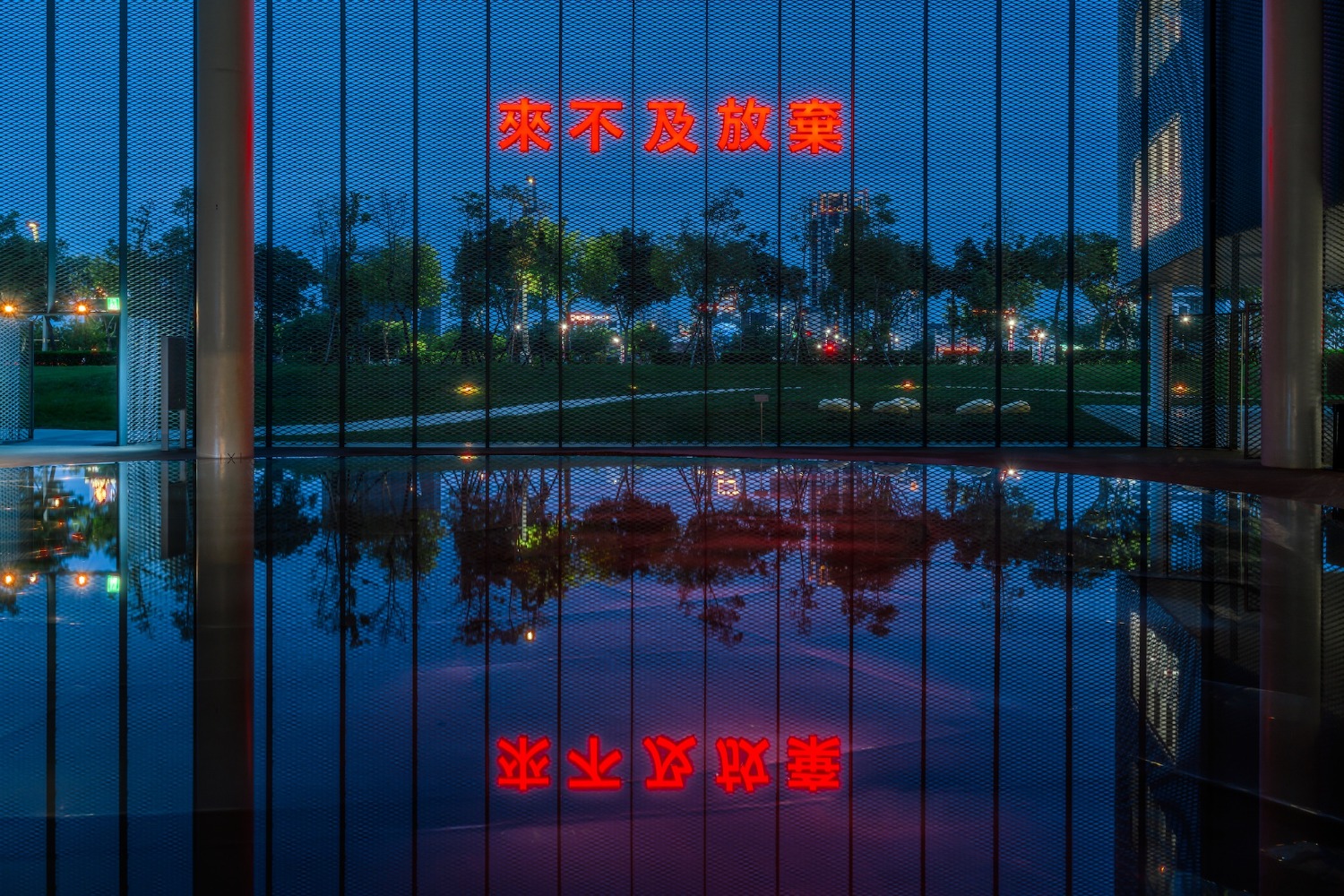
- Neli Ružić (b. 1966, Split, Croatia): It’s Too Late to Give Up, a light inscription rendered in Chinese as 來不及放棄, is situated in the Taichung Green Museumbrary lobby. By connecting past and future imaginaries, the installation serves as a beacon for TcAM’s new journey, signifying an era of resilience and deepened public participation.
- Donna Conlon & Jonathan Harker (b. 1966/1975, Panama): Renowned for dissecting geopolitics through satire, their works are included in the collections of institutions such as Tate and Guggenheim. Drinking Song applies Panamanian beer bottles to play the US national anthem, critiquing the complex ties between the two nations, whilst Tropical Zincphony captures the rhythmic journey of mangoes falling onto zinc roofs.
- Liao Jui-Fen (b. 1968, Taichung, Taiwan): In Summer Morning, the artist projects her youthful uncertainty whilst studying in Japan through the figure of a woman. Using cool grayish blues and purples to evoke a hesitant atmosphere, the work captures the essence of an expatriate student. This work is a premier example of contemporary Eastern Gouache in the TcAM collection.
- Buen Calubayan (b. 1980, Manila, Philippines): The project Poetic River dialogues with Filipino artist Guillermo Tolentino’s archives, translating the Tagalog word for “yes” (Oo) into a lemniscate (∞). This symbol traces the trajectory of thermal energy during a fever, framing the body as a cosmic mirror—as above, so below—to re-examine the relationship between the self and the world.
The Covenant of Dadu: A Diplomacy of Things between Mountain and Seas is the culmination of a two-year art history research initiative. Its name honors the Dadu Plateau—a symbolic highland that has witnessed Central Taiwan’s historical transformations. Curated by art historian Shen Yu Chang and featuring works by 55 artists, the exhibition introduces the concept of “a diplomacy of things.” It proposes that the urban fabric is formed through continuous negotiations between land, infrastructure, ecology, and human agency. By mapping artistic developments across railways, harbours, craft traditions, and agricultural systems, the exhibition redefines Central Taiwan not merely as a geographic region, but as an evolving site of cultural production.
Highlights of The Covenant of Dadu
- Suiba Kunishima (b. Nagoya, Japan): A pioneer of satirical manga in Taiwan under Japanese rule in the early 20th century. His Taiwan Manga Chronicle is displayed in its entirety for the first time in years, alongside 12 selected pieces that serve as a thematic guide to the exhibition’s narrative.
- Yen Shui-Long (1903–1997, b. Tainan, Taiwan): Dedicated to Taiwanese arts and crafts, his Bamboo Living Room Chair integrates modern geometric lines into traditional local craftsmanship, elevating bamboo furniture to a modern aesthetic.
- Chen Hsia-Yu (1917–2000, b. Taichung, Taiwan): Known for his signature rounded female forms, the artist offers a rare study of the male figure in Laborer. Part of the TcAM collection, the sculpture poignantly freezes the transition between a moment of rest and the imminent return to work.
- Lin Chih-Chu (1917–2008, b. Taichung, Taiwan): An important Taiwanese Eastern Gouache painter. His masterpiece, Taichung Park, captures the iconic Taichung Park Mid-Lake Pavilion and the lines of vegetation, evoking the city’s unique cultural atmosphere in the 1980s.
Situated within the Taichung Green Museumbrary, TcAM is dedicated to becoming a sanctuary where environment, knowledge, and art converge. With the launch of its summer season, the museum solidifies its role in curating local art history whilst fostering international dialogue. For more information, please visit https://www.tcam.museum/en