A carved-pillar frame harp depicted particularly frequently on fourth-century BCE vases from southern Italy can now be played in two modern versions. According to Barnaby Brown, co-founder of Lotos Lab and one of the musicians coordinating the project, they are the first known modern examples of this particular harp type.
From 23 November, the two instruments will be brought together at Moyseion in Matera’s Sassi for a four-day experiment involving musicians, scholars, instrument makers and participants. They will compare tunings, playing techniques, rhythm, vocal accompaniment and composition, using sound to investigate questions that written and archaeological sources cannot resolve on their own.
Both prototypes were made by musical instrument maker Marco Sciascia. The first was commissioned by Moyseion in 2021. The second, completed in 2026 and subsequently acquired by Moyseion, develops that initial experiment while incorporating archaeological evidence that was not available at the time.
The project opens the second season of a multi-year collaboration between Moyseion and Lotos Lab, a UK organisation specialising in ancient music research, instrument making and performance.
What makes this harp different
These are not the first modern reconstructions of ancient harps in general. Their distinction lies in the specific type of instrument represented on southern Italian vases. On this harp, the shorter, higher-pitched strings sit close to the player, while the longer, lower-pitched strings are positioned at the opposite end.
Earlier reconstructions of ancient Greek harps have focused primarily on the trigonos, which has the reverse arrangement, with the lower-pitched strings closer to the player. Interest in the trigonos grew in particular following the discovery in Athens in 1981 of the ancient Daphne harp. The instrument was meticulously studied and reconstructed by Christos Terzis, who published his findings in 2013.
The construction of the two new prototypes also differs markedly from that of more familiar Western harps. A hollowed-out soundbox is covered with animal hide. A central spine runs along the hide and the strings are tied through it. Their tension stretches the membrane, causing it to vibrate and amplify the sound.
The aim is not to make an instrument that resembles the harps painted on ancient vases while producing the sound of a modern Western harp. Instead, the research investigates the instrument’s acoustics, its response beneath the player’s fingers and its possible tone colours, while recognising that no surviving source can establish with certainty what the original instrument sounded like.
From vase painting to playable instrument
The process does not begin with a single image to be copied. Researchers compare numerous vase paintings, examining the form of the instrument, the arrangement of its strings, the player’s position and structural elements that recur across different representations.
Ancient images, however, are not technical drawings. They may simplify, distort or omit details, leaving the researchers to distinguish between decorative features and possible evidence of construction methods. One example is the jagged profile running along the top of the soundbox in some Apulian vase paintings, described by the researchers as a “dragon’s back” or “cockscomb”. It may be purely decorative, but it could also represent the edge of a hide tied and stretched over the soundbox in a manner similar to the membrane of a drum. Experimental instrument making makes it possible to test the practical and acoustic implications of such interpretations.
The imagery is considered alongside archaeological fragments of instruments from Greek and Egyptian contexts, ancient literature, music theory and surviving musical notation. The researchers also compare harps from other periods and cultures, including evidence from China, Burma, Georgia and several African countries. The ngombi of Gabon, which belongs to a living harp tradition, is particularly instructive. It is not treated as a direct model for the ancient Greek instrument. It does, however, make it possible to observe aspects that a vase painting cannot preserve, such as string tension, finger movement, playing posture, the transmission of technique and the cultural understanding of sound.
Sciascia translates these different strands of evidence into practical construction choices. Musicians and scholars then test the prototypes, assessing their sound, response to touch, stability and ease of tuning. Their observations lead to modifications, further experiments and new questions. Some decisions must also respond to twenty-first-century requirements, including the need for the instruments to withstand centrally heated rooms and to be transported safely.
The fragment stored in Athens for more than a century
The second prototype also takes account of selected evidence from a fragmentary stringed instrument found in Tomb Z at Demetrias. The artefact spent more than a century in the stores of the National Archaeological Museum in Athens before its significance for ancient harp research was recognised. It is being studied by Maria Stamatopoulou of the University of Oxford and Christos Terzis, who is affiliated with the University of Vienna and the Austrian Archaeological Institute. Initial findings were presented in November 2025 at the 13th Symposium of the International Study Group on Music Archaeology. The evidence was subsequently discussed with musicians and instrument makers during a research residency held at Moyseion in February 2026.
The researchers stress an essential distinction: the second prototype is neither a replica nor a reconstruction of the Demetrias harp. It is a modern experimental instrument developed by considering selected evidence from the artefact alongside fragments from other instruments discovered in Greek and Egyptian tombs, southern Italian iconography, ancient texts, organological comparisons and harp traditions from different parts of the world. Detailed drawings, measurements and interpretations of the Demetrias fragment are still being studied and have not yet been published. It is therefore not possible to attribute the ancient artefact’s precise dimensions, materials, number of strings or other characteristics to the modern prototype.
Seven or ten strings per octave
In November, the two prototypes will be played and compared directly, with new music composed so that the instruments can also be heard together. One will use a diatonic arrangement of seven strings per octave, familiar to contemporary harpists. The other will test a denser chromatic configuration of approximately ten strings per octave, allowing altered notes to be played without adjusting individual strings through levers, pedals or finger pressure.
This second hypothesis also emerges from the shape of some harps depicted on ancient vases. Where the soundbox curves more strongly, the bass strings appear closer to one another in length and may therefore have been tuned at narrower intervals. This remains one possible interpretation rather than an established fact, but the researchers have identified supporting evidence in both ancient iconography and the notation of surviving vocal melodies.
The working programme includes Mesomedes’ Invocations of the Muse and of Calliope and Apollo, the Seikilos Song and the diatonic and chromatic sections of Athenaios’ Paean. The researchers will also compare posture, hand movement, vocal accompaniment and interaction with the lyre, aulos and frame drum. Particular attention will be given to rhythm and to the relationship between the musician’s body and the playing positions represented on Apulian vases.
The residency is expected to produce music and teaching videos, scores, technical exercises and new repertoire for students. The work will also contribute to defining the specifications of future models for students and professional musicians. The team is also developing a Lotos Lab harp kit that would allow users to assemble the instrument themselves, apply a real goatskin and attach the strings.
Ancient sources and new music
More than fifty examples of written music survive from ancient Greece, preserved on papyrus or carved into stone. Many are fragmentary and must still be interpreted or completed before they can be performed. A different form of research concerns poetic texts known to have been sung with instrumental accompaniment but whose original music has not survived.
During the project’s first season, musicians, scholars, instrument makers and participants developed four new historically informed musical settings connected with Alcman’s Partheneion, Sappho’s Call to Aphrodite, Pindar’s Olympian II and Paean IX. These are not ancient compositions recovered in their original form. Melody, rhythm, accompaniment, instrumental parts and playing techniques were tested and reworked collectively, using the metre of the texts, ancient music theory, surviving notation and practical experimentation.
The 2025-2026 season recorded 41 attendances across five courses, including repeat attendance by participants who joined more than one. They came from ten countries and included professional musicians, students, doctoral researchers, teachers, museum staff, composers, classicists, singers, dancers and instrument makers. Four lyres, six bass auloi and 32 pairs of reeds were made during the courses. A separate 32-hour programme was delivered for 23 students from Matera’s Tommaso Stigliani Music High School. Materials developed at Moyseion were subsequently presented at the 17th MOISA Conference at Université Côte d’Azur and during a lecture-recital at the University of Cambridge’s Faculty of Music.
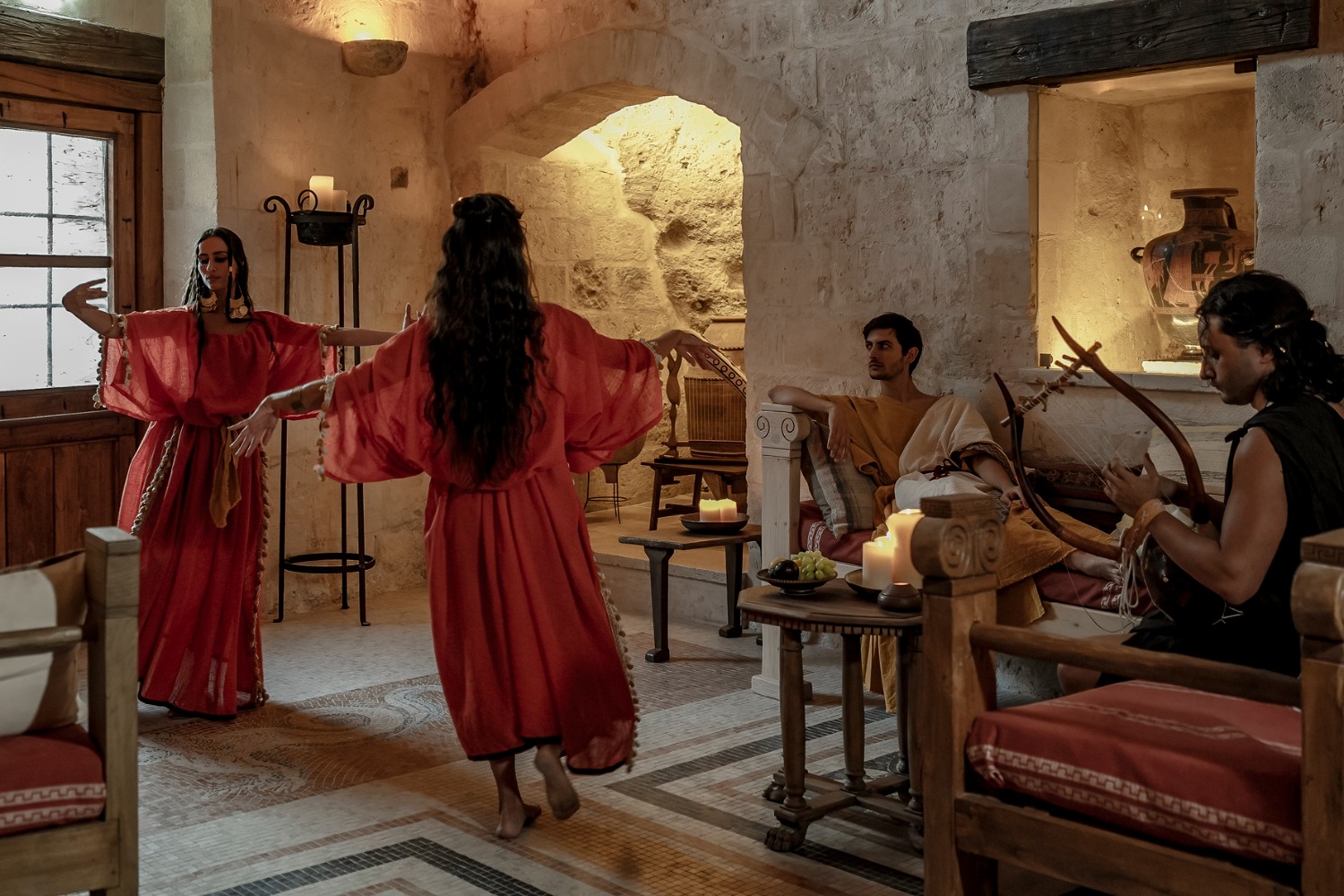
“When we imagined Moyseion, we did not want a place where the past remained sealed inside a display case. We wanted something to happen again,” says Antonio Panetta, founder and curator of Moyseion. “Here, fragments, images and texts become instruments, experiments, voices and shared music. Guests encounter research as it takes shape, with its doubts and discoveries: for us, this is the meaning of an inhabited museum.”
The harp residency will open a programme continuing until 18 March 2027, comprising four research residencies, four practical courses and eight public music events. Subsequent sessions will investigate ancient Greek dance and song, the lyre and the aulos.