Detailed plans have been unveiled by Derby’s two Business Improvement Districts (BIDs) to streamline operations in the city.
Under the proposal, the existing Cathedral Quarter Business Improvement District (BID) and the St Peters Quarter Business Improvement District (BID) will merge together to form a single and more coordinated Derby BID.
The aim is to create a stronger presence in Derby, expand coverage and amplify services across the city. Under one joined-up structure, which will also cover the growing Becketwell Quarter, the new single BID will represent nearly 1,000 businesses across the city with a unified platform to work with partners, champion priorities and shape the future of the city.
Levy paying businesses in Derby are being consulted on the new Derby BID model and have been invited to ask questions and share their views on the planned merger. The new business plan outlines a model that will join both BIDs and create one single one.
A members’ ballot will then be launched in the Autumn.
Brad Worley, BID Manager for Cathedral Quarter and St Peters Quarter, said: “This is a pivotal moment for Derby, and we are excited to combine our resources and ambitions under one BID.
“For years, Cathedral Quarter BID and St Peters Quarter BID have worked with passion and purpose on behalf of city centre businesses, helping to create a cleaner, safer, more welcoming and more vibrant Derby.
“Together, they have supported traders, championed the city, delivered events, backed crime reduction initiatives, invested in the public realm and helped businesses make their voices heard.
“A single Derby BID will bring a stronger voice for city centre businesses, and this is one of the reasons we are discussing these plans with levy payers.
“Obviously, there will be a period of consultation and engagement, but we think this is a real opportunity for business in the Cathedral Quarter BID and the St Peters Quarter BID to come together now.
“What we want to do is create a shared vision for a stronger city and work under one single BID. The single BID will mean that businesses across the city centre will be represented together and can enjoy a more joined-up future.”
The new Derby BID will streamline operations, pool resources and help to secure larger-scale investments and organise wider-reaching community events. It will enable the new BID to reinvest in high-impact projects that enhance the BID areas’ public spaces, visitor experience and business support – while significantly reducing duplication of efforts.
Last year, (2025) three of Bristol’s Business Improvement Districts – Bristol City Centre, Broadmead, and Redcliffe & Temple – officially united into a single, cohesive entity. Following a successful ballot, the new collective streamlined operations in the city.
While Derby City Council does not control the BIDs, it plays many roles in collecting a levy from businesses, holding the ballot, and voting itself as a property owner in the area. BIDs charge a levy on firms inside their area, to help pay for improving trading conditions.
The work carried out by BIDs includes putting on events to attract shoppers like Celebrate Sadler Gate and Jurassic Day, marketing, improving the public area, and providing support and training for businesses. Firms are charged a small percentage of the value of their property, with exemptions for small businesses.
Helen Wathall MBE, chair of the St Peters Quarter Business Improvement District (BID), said: “One stronger BID will give Derby a more joined up, more effective, stronger presence in the city – and I welcome this.
“A single Derby BID means businesses across the city will be represented together so we can champion priorities and shape the future of Derby.”
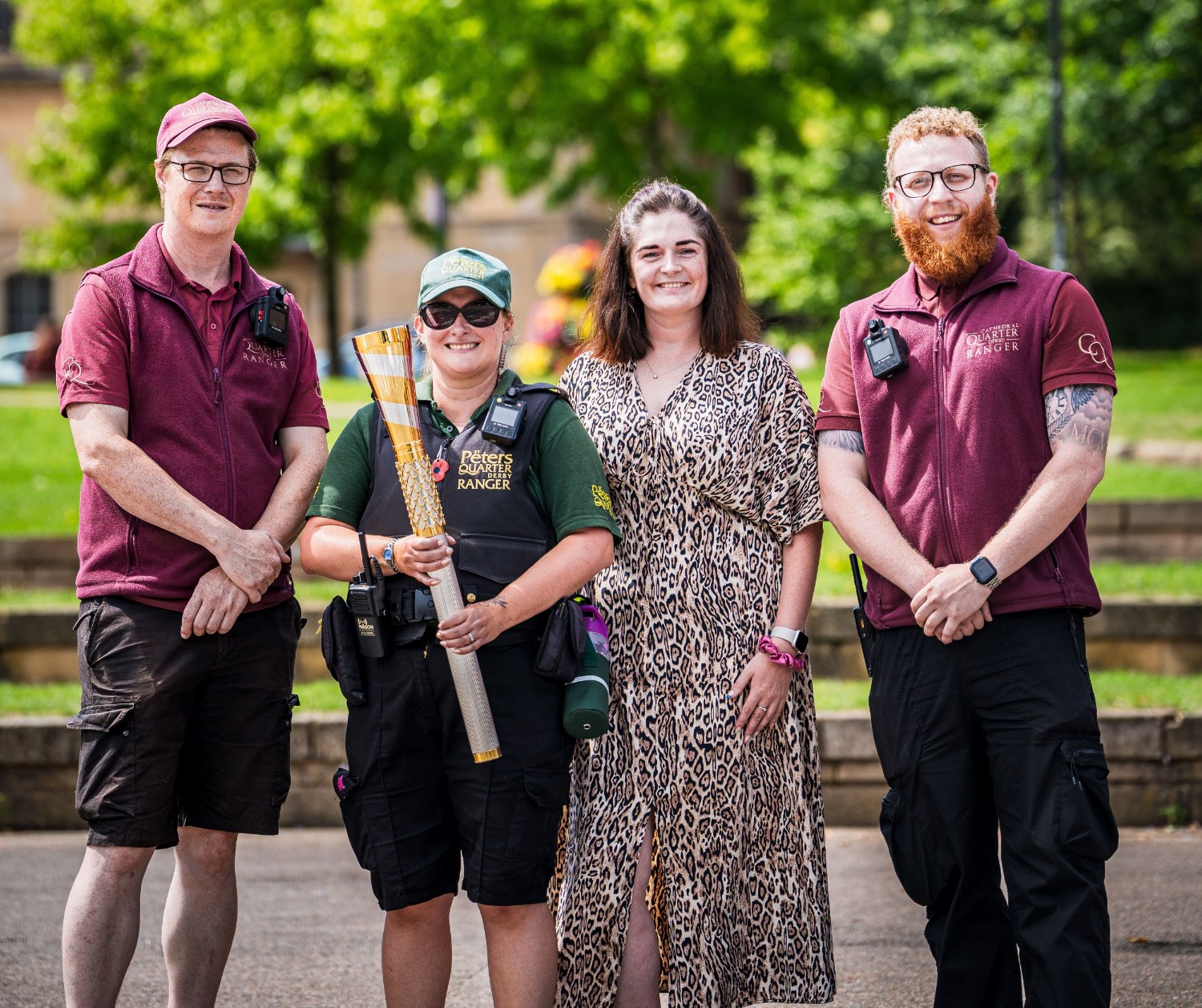
Caption: From left: Rangers Jon McKenzie, Nikki Matthews, Gemma Pindard, Deputy Manager for both Cathedral Quarter BID and St Peters Quarter BID, and Ranger Scott Harris.