
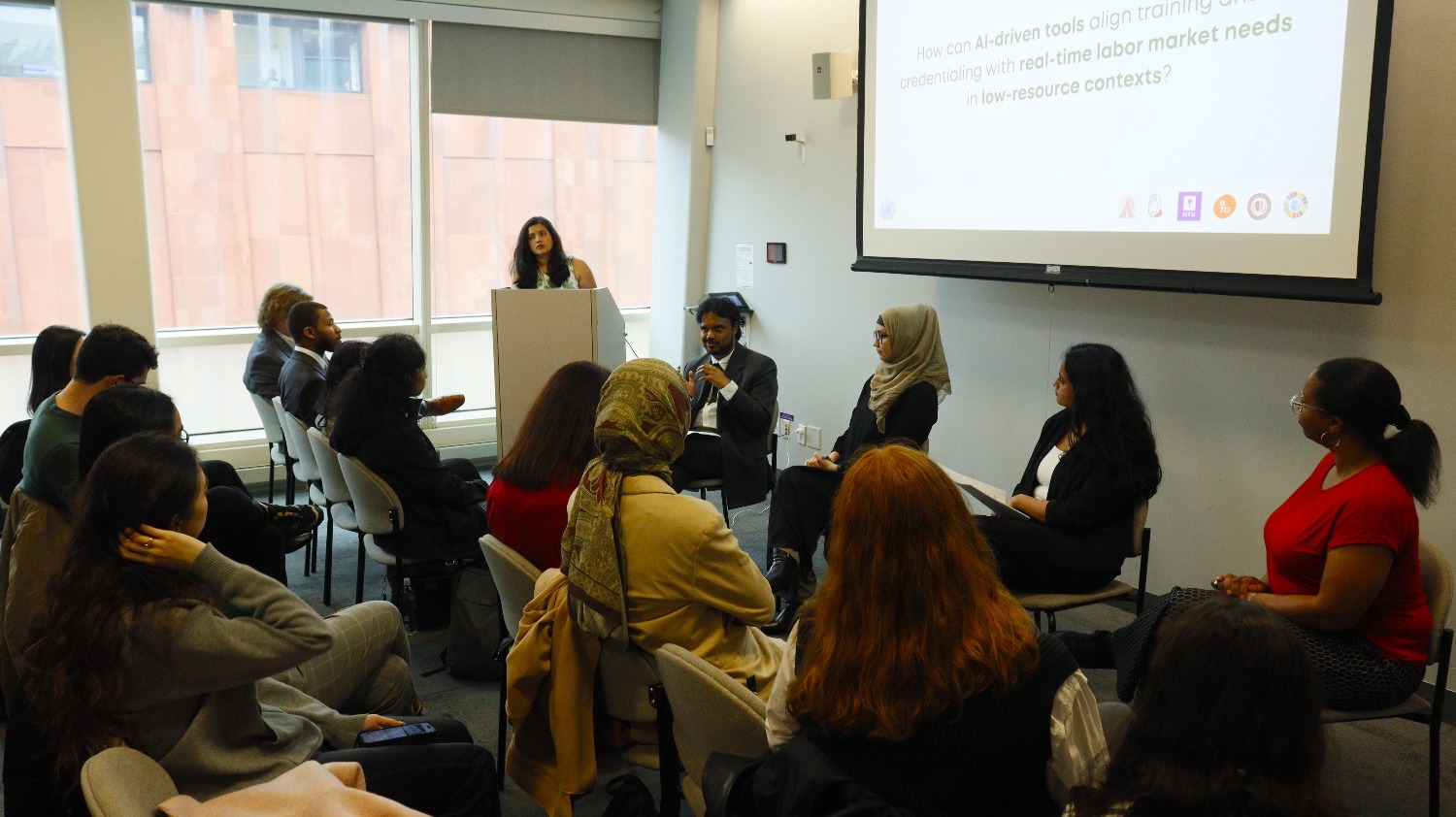
International experts explore how artificial intelligence can match young women with better careers while addressing systemic barriers
BacharLorai Global, an award-winning social enterprise enabling development worldwide through community, research and welfare programs, convened a high-level panel discussion at New York University’s Kimmel Center during the 70th session of the United Nations Commission on the Status of Women (CSW70) on March 12, 2026.
The panel, titled “Jobs for Girls: Leveraging AI to Match Young People with Better Careers,” brought together experts from technology, healthcare, academia, and policy to examine how artificial intelligence can expand economic opportunities for women and girls worldwide.
The event marked BacharLorai Global’s third consecutive year participating in CSW, following successful panels at CSW68 and CSW69. Building on its 2025 policy brief Jobs for the Future: Bridging Urban-Rural Unemployment Inequities of Bangladeshi Youth, the panel addressed urgent questions about AI-powered job matching, alternative career paths including gig work and remote roles, closing the digital skills gap, and building technology that works for everyone. With 85 percent of countries—primarily in low and middle income communities—lacking national AI regulations, panelists examined how to ensure women and girls benefit from technological transformation rather than being further marginalized.
Opening Remarks:
Aki Temiseva, President and CEO of the United Nations Association in Canada, a global development leader with extensive international executive experience across nonprofits and social impact initiatives, opened the proceedings by framing both the promise and peril of AI adoption:
“These technologies that bring some risks also hold enormous potential to open doors. AI-powered platforms can help match young people with career opportunities they may never have otherwise discovered. Remote and digital work can bridge rural and urban divides. But technology alone will not create equity. It must reflect the realities of the communities it serves and ensure that women and girls are not only participants in the digital economy, but leaders shaping its direction.”
Temiseva closed with a quote from Nelson Mandela: “It’s always impossible before it’s done.”
Cemre Ulker, Representative to the United Nations for the Journalists and Writers Foundation, highlighted emerging threats facing women professionals:
“About 73 percent of women journalists are noting that they face a form of digital threat. What starts as virtual never remains there. It extends beyond screens, extending boundaries, and when there is impunity, when there is lack of accountability, women professionals are usually imposing self-censorship on themselves and on how they structure their professional careers.”
Ulker noted recent UN efforts to address these challenges, including the Secretary-General’s independent 40-member scientific panel on artificial intelligence and the new Convention against Cybercrime adopted by member states.
Nicholas Kimble of the UN Youth Office highlighted the timeliness of the discussion, noting the office’s focus on youth mental health and well-being:
“We’ve worked on youth cyber mental health, and that’s where it comes into today’s conversation. Hopefully we can come to solving some of these issues that face all of our communities, and especially towards women.”
Panel Highlights:
Dr. Kristin Austin, Vice President of Culture and Community Impact at Rewriting the Code, which supports over 40,000 women in tech careers, challenged the audience to consider who truly benefits from technological progress:
“I think of AI as a tool that both extends our opportunities, but I’m constantly in this nuance between extension and amputation. Specifically when it comes to women and girls, especially low income, underrepresented—anytime a new opportunity is presented that furthers the already privileged workforce, we’re always going to see this continued amputation. The only way to ensure equitable outcomes is to de-center yourself.”
Dr. Austin illustrated the importance of community-centered design through a powerful analogy about well-meaning outsiders who repeatedly installed lights in a neighborhood park, only to have community members remove them—because, as residents explained, “at night, when it’s lit up, that is when we see more crime happen.” The story underscored how solutions designed for communities rather than with them can cause unintended harm.
Dr. Austin also highlighted a critical pipeline problem in technology: “In the U.S., more women enter computer science degree programs than do men. But less women matriculate. At every year—first year, second year, third year—women are pulling themselves out or being pushed out due to biases.” She emphasized that financial barriers compound this attrition, noting that “where you spend your money is where your priority is,” and called for removing financial obstacles at every entry point from college through early career.
Sila Gecir, Therapist at Marble Health, priorly an Internship Manager at Stony Brook University who connected students to career pathways in tech and public service, spoke to AI’s potential to democratize career development—while cautioning against losing the human element:
“AI does a great job of breaking through barriers. Before, when you wanted to get your resume reviewed, you had to hire a career coach or know someone in the field. Accessibility is such a great way for this to open up opportunities. But it’s never just about the skills. What are your goals? What drives you? How do we help you find meaningful careers and not just a quick one?”
Gecir encouraged attendees to take action at any scale: “It doesn’t have to be a big change where you’re running for president. Talk about these issues with your friends, go to your school, cultural centers, libraries—public spaces where you can have these conversations.”
Saloni Patel, Outreach Officer at Kamakhya Health Organization, who focuses on ethical AI and machine learning to improve health and livelihood outcomes for marginalized communities, emphasized the critical importance of inclusive data:
“AI is not neutral. It’s going to reflect the world as it has been recorded—hierarchies, blind spots, exclusions. When you train AI on biased data, biases don’t disappear. They just become a part of what the AI considers normal. We need more inclusive data, and by inclusive I mean data that is inclusive of women and girls and their perspectives.”
Patel also called for greater transparency from the private sector: “There’s such a huge gap in wages between men and women, and the data is available—people are choosing not to provide it. Let’s ask them for it.”
Al-Amin Ahamed, 2024-25 Policy Resident at BacharLorai Global, who researches digital skills and youth employment in Bangladesh, articulated what genuine co-design requires:
“The biggest risk without engaging with communities is we’re not solving problems—we are making them worse. Genuine co-design means shifting from designing for communities to designing with communities and putting them at the center. This means early engagement before a system is made, participatory design where communities have a say in what skills they’re looking for, and shared governance to monitor whether these systems are actually improving outcomes.”
Al also cautioned against assuming universal access: “When we talk about having access to AI tools, we’re assuming access to reliable internet, digital literacy, technical infrastructure—and that’s not available globally. In many rural contexts, particularly for girls and women, these prerequisites are not guaranteed.”
Audience Discussion
During the Q&A session, David Marvin, MS Urban Planning candidate at Columbia University, raised questions about the physical and environmental impacts of AI infrastructure, noting that data centers require substantial water and copper resources, and that communities in low and middle income countries are increasingly pushing back against their construction. Dr. Austin responded by emphasizing the importance of early, compensated engagement with community leaders: “If you can tap into grassroots leaders and pay them—I cannot stress this enough, lean on voices, especially under-resourced voices, and compensate them—then you can start embedding this information now, before you’re asking someone to make a big decision” such as facilitating the space and resources for a data center.
Another attendee asked how to advance women’s leadership in AI governance when women remain underrepresented in decision-making spaces. Panelists emphasized mentorship, removing financial barriers, and the principle of “nothing for us without us”—ensuring that affected communities shape the policies that govern them.
Looking Ahead
When asked what measurable change would signal progress in five years, panelists offered focused responses:
Dr. Austin: “Retention of women in technical roles, regardless of career interruptions, and measurement of career distress.”
Al-Amin Ahamed: “Intersectionality—having more open discussions where diverse, multidisciplinary expertise comes together.”
Saloni Patel: “Tech treated as a right—embedded into learning systems and accessible to everyone.”
Aditi Zahir, Director of Policy Research at BacharLorai Global, who moderated the panel, closed the session by returning to a central question posed at the opening: “Who benefits from AI, and who gets left behind? We have to bring that question with us in all we do, and be vocal about it, and keep asking the questions—and sometimes answering them as well.”
Zahir also shared recent data from the World Bank’s Women Entrepreneurs Finance Initiative 2026 report: while 49 percent of women participate in the labor force globally, only 34 percent of private firms are owned by women, and just 19 percent of top management positions are held by women—underscoring the urgency of the panel’s focus.
“We are very grateful to every organization that made this event possible, and having UN participation is a fantastic milestone for BacharLorai,” said Anil Wasif, Co-Founder and Managing Director of BacharLorai Global. “Our third consecutive year at CSW demonstrates our commitment to elevating underrepresented voices in global policy discourse and ensuring that low and middle income communities have a seat at the table as AI reshapes the future of work.”
