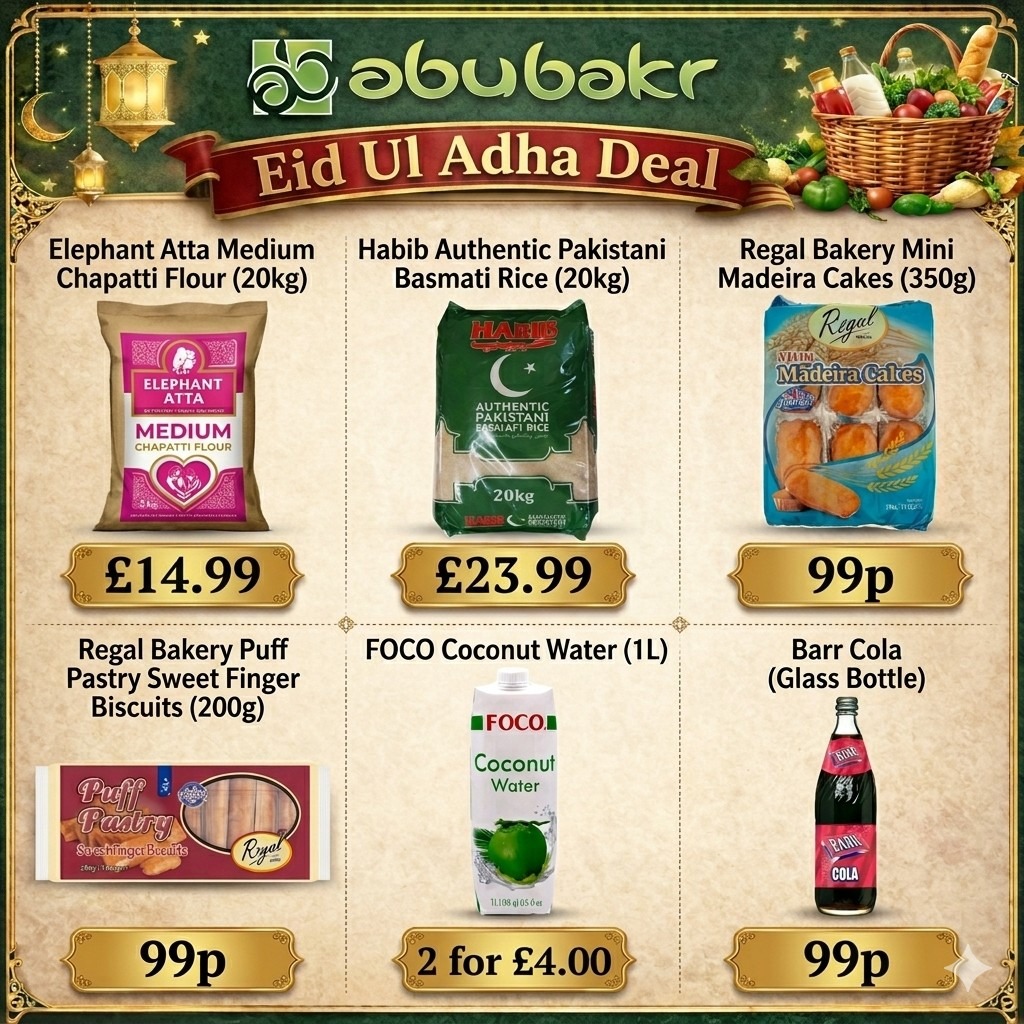
Abu Bakr Supermarket has launched its Eid ul Adha Sale across its stores in Leeds and Batley, as new analysis suggests the festival could help generate more than £140 million in spending across Yorkshire.
The retailer has introduced discounts on a wide range of household essentials, including flour, rice, cooking oil, spices, dairy products and desserts, as families prepare for one of the most significant dates in the Islamic calendar.
The sale follows a strong Ramadan period, which is estimated to have contributed around £174 million to the Yorkshire economy, based on household spending patterns.
With approximately 442,000 Muslims living in the region, the most accurate way to assess economic impact is by household:
Estimated households: 442,000 ÷ 3.8 = 116,000 families
Average household size: 3.8 people
During Ramadan and Eid ul Fitr, average household spending is estimated at around £1,500, leading to a total of approximately £174 million.
Even using a more conservative estimate of 110,000 households spending £1,200, the total still reaches £132 million.
While Eid ul Adha differs in nature – with spending concentrated over a shorter period – it remains a major economic driver.
Using the same household-based model, but adjusting for a shorter festival window, average household spending is estimated at between £950 and £1,200 during Eid ul Adha.
This leads to projected totals of:
116,000 households × £1,200 = £139 million
Conservative estimate: 110,000 households × £1,000 = £110 million
This places total Eid ul Adha spending between £110 million and £140 million across Yorkshire.
Unlike Ramadan, where spending is spread across daily meals and staples, Eid ul Adha spending is more concentrated and focused.
The largest share is driven by meat purchases, with strong demand for fresh halal lamb and beef as families prepare traditional meals.
This is followed by increased spending on food and hospitality, as households host gatherings, alongside seasonal purchases such as clothing and gifts.
Abu Bakr Supermarket says its Eid sale is designed to support families while also driving wider economic activity.
Hamza Hussain, CEO of the company, said: “Ramadan showed the scale of spending across our communities, and Eid ul Adha continues that momentum in a more concentrated way.
“Families are still coming together, preparing meals and celebrating, and that creates strong demand across food and retail.”
He added: “As a Yorkshire-based national retailer, we work closely with local suppliers and staff, meaning this increased activity has a direct impact on jobs and businesses across the region.”
Although Eid ul Adha spending is slightly lower than the £174 million generated during Ramadan and Eid ul Fitr, the combined effect means Islamic festivals contribute well over £250 million annually to Yorkshire’s economy.
With retailers, suppliers and communities preparing for the celebrations, Eid ul Adha is set to deliver another significant boost – reinforcing its growing importance to the region’s economic landscape.