A street-art tradition made permanent — a Jubilee gift between two villages — a thread running from the apocryphal Gospels to Titian to a chapel in a Lazio borgo
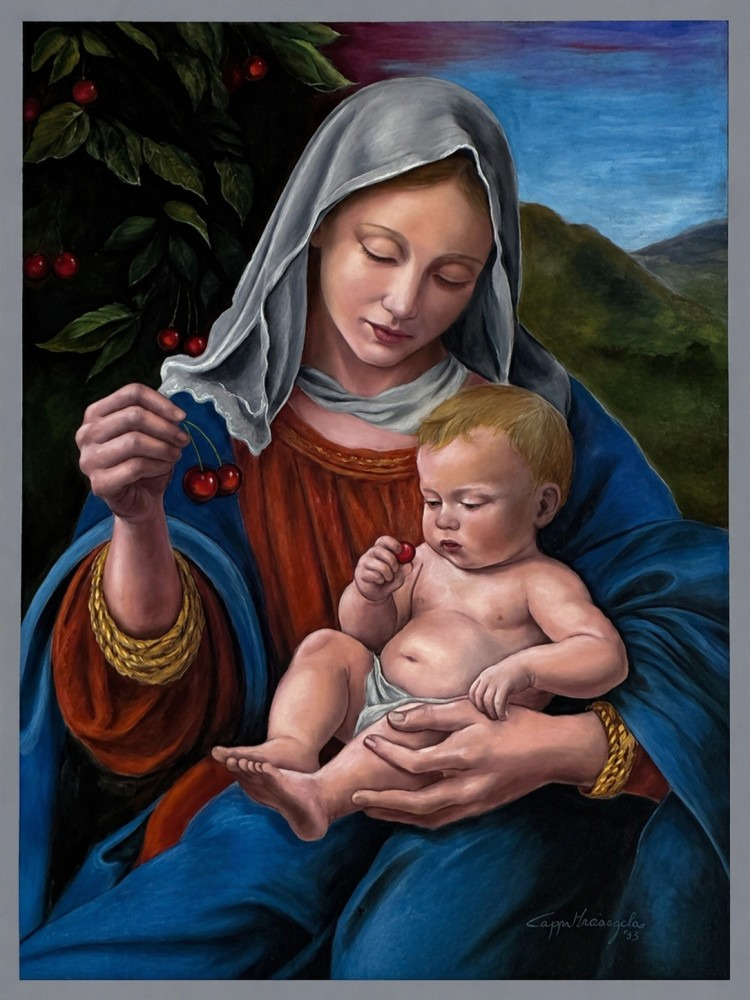
For centuries, the madonnari depicted sacred images on street pavements, knowing that they would be erased by the rain. This Friday, May 29 at 9 pm in Celleno — a village of 1,300 inhabitants in the Tuscia region, 100 kilometers north of Rome — that ephemeral tradition becomes permanent: a Madonna of the Cherries created using colored chalks on a wooden panel, fixed with a special seal is now the devotional image of a newly inaugurated Marian cult.
The official inauguration takes place on Friday, May 29, 2026, at 9:00 pm, as the Marian month of May draws to a close. A candlelit procession will depart from the Church of San Donato in Celleno and wind its way through the village passing all of its historic roadside shrines – placing faith at the heart of the Celleno annual Cherry Festival, one of the most quintessential events of the Tuscia region.
An Image That Has Traversed the Centuries Almost in Silence
The Madonna of the Cherries is one of the most beautiful, poignant and theologically layered figures in all of Christian sacred art — and one of the least known. Titian painted her in 1516. Federico Barocci painted her in 1573 (the work now hangs in the Vatican Pinacoteca, steps from St. Peter’s). The motif traces its roots to the apocryphal Gospel of Pseudo-Matthew, in which the infant Jesus commands a palm tree to lower its fruit for his mother. The cherry — symbol of the Passion, of redemption, of divine providence — passed from the Gospels into centuries of sacred painting, and from painting into popular devotion.
In Celleno, it finds a new home. And with it, a new cult.
The Ephemeral Made Eternal
The painting at the heart of this inauguration is a work of genuine rarity. Mariangela Cappa, an Italian artist of international standing, three times winner of the National Encounter of Madonnari in Grazie di Curtatone (2007, 2011, 2016), the most prestigious gathering of sacred street artists in Italy created the image using colored chalks on a wooden panel, then fixed it with a special seal.
The technical choice carries its own symbolic weight. The madonnari tradition is by definition ephemeral: sacred images on pavements, destined to be washed away by the rain. Here, for the first time, the street becomes an altarpiece. The ephemeral is made eternal.
The work is housed in a dedicated chapel inside the Church of San Donato, in the modern part of Celleno. Those who encounter it describe being drawn immediately into its beauty, charm and grace – an image that invites contemplation and reflects centuries of theology, iconography and Marian devotion.
A Jubilee Bridge Between Two Villages
The painting was donated in 2025 by the Municipality of Ceresara (Province of Mantua, Lombardy) to the Municipality of Celleno (Province of Viterbo, Lazio) as a concrete act of their institutional twinning and a gift for the Jubilee year. The gesture carries a precise symbolic logic: both communities share the cherry as their defining local fruit and agricultural heritage. A bond of territory, tradition and faith — running from northern Italy to central Italy — finds expression in a single devotional image.
“This moment of prayer before the Madonna of the Cherries will be the beating heart of our festival. We thank the Lord for this wonderful fruit He has given us, a sign of His generosity and providence toward our families and our land. We thank the Municipality of Ceresara for this precious gift, which enriches our chapel and strengthens the bond between our communities. May the Virgin bless our trees, our families and all those who come to share our joy.” — Don Giusto Neri, Parish Priest of Celleno
MEDIA ASSETS https://drive.google.com/drive/folders/17qEy8ROAbXTcprnGUW2-Flovzk8rnr-E