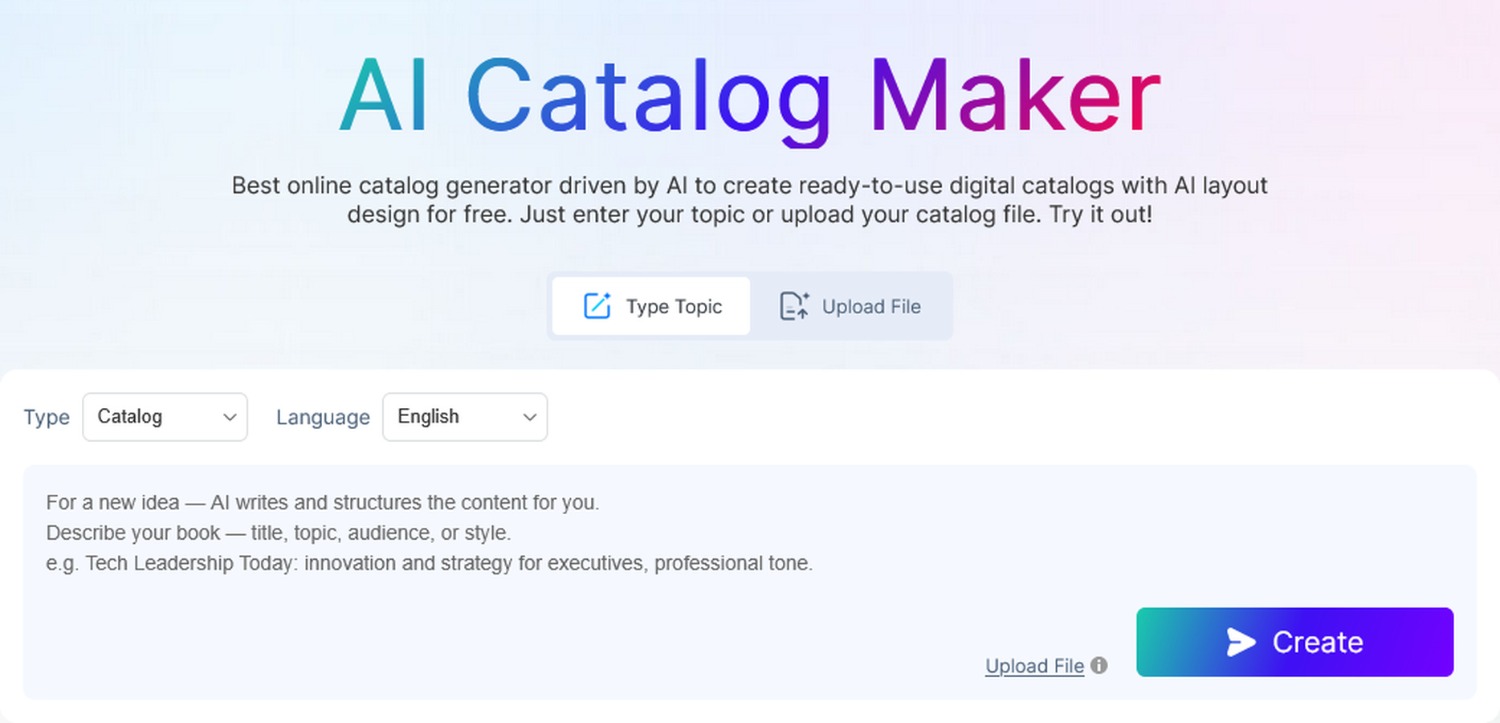
Producing a product catalog the traditional way usually means coordinating designers, spreadsheets, and repeated revision rounds before a single spread is ready to publish. FlipHTML5 tackles that bottleneck with its AI catalog solution, which converts scattered product details into a finished, page-flipping publication in minutes. Instead of laying out every page by hand, teams describe what they need and let the platform handle both structure and design, putting an AI catalog within reach of people who have never opened layout software.
Two creation methods keep the workflow flexible. With Type Topic, the user describes the catalog in a text prompt—products, sections, tone, and target buyers—and can optionally attach a Word or PDF file so the AI rewrites and reorganizes that material to match the instructions. With Upload File, the user uploads a finished document and the AI leaves every word intact, applying a professional page design without touching the content. Building an AI catalog from scratch or refreshing an existing range both fit neatly into these two paths.
Once the input is submitted, the AI drafts a structured outline the user can review before committing. After that, the creator picks a layout template and a theme color, and the system renders each page to match. The outcome of generating an AI catalog is a cohesive document where typography, spacing, and imagery already look considered rather than assembled in a rush.
The finished file is never locked. Every publication opens in the FlipHTML5 page editor, where users refine wording, swap fonts and colors, and add images, video, audio, or hyperlinks to make listings interactive. Teams that want a running start can also browse ready-made catalog templates and adapt one to their range, then complete it through the same AI catalog workflow. For businesses that already keep their range in a designed PDF, FlipHTML5 offers a straightforward way to turn that file into a digital catalog with a page-flip effect while preserving the original layout—an approach that complements the AI catalog route when the source design is final. However it is built, the publication can be shared by link or QR code, embedded on a website, or downloaded for offline viewing.
“Our aim is to remove the production drag that stops smaller teams from publishing polished work,” said Winston Zhang, CEO of FlipHTML5. “With the AI catalog tool, a marketer can go from a simple prompt to a professional, on-brand showcase without waiting on a designer or learning new software.”
To learn more about how to create an AI catalog, please visit FlipHTML5.