Why inefficient lighting is costing South African industry twice
By Andrew Winstone: CEO of Energy LED
South African industry does not need another abstract conversation about carbon. It needs credible ways to cut avoidable costs and reduce exposure to a carbon-constrained economy without waiting for a major new capital allocation. That is why one of the most practical decarbonisation opportunities in manufacturing is also one of the most overlooked: eliminating the electricity wasted every day by inefficient legacy lighting, including HID and fluorescent systems, across large industrial sites.
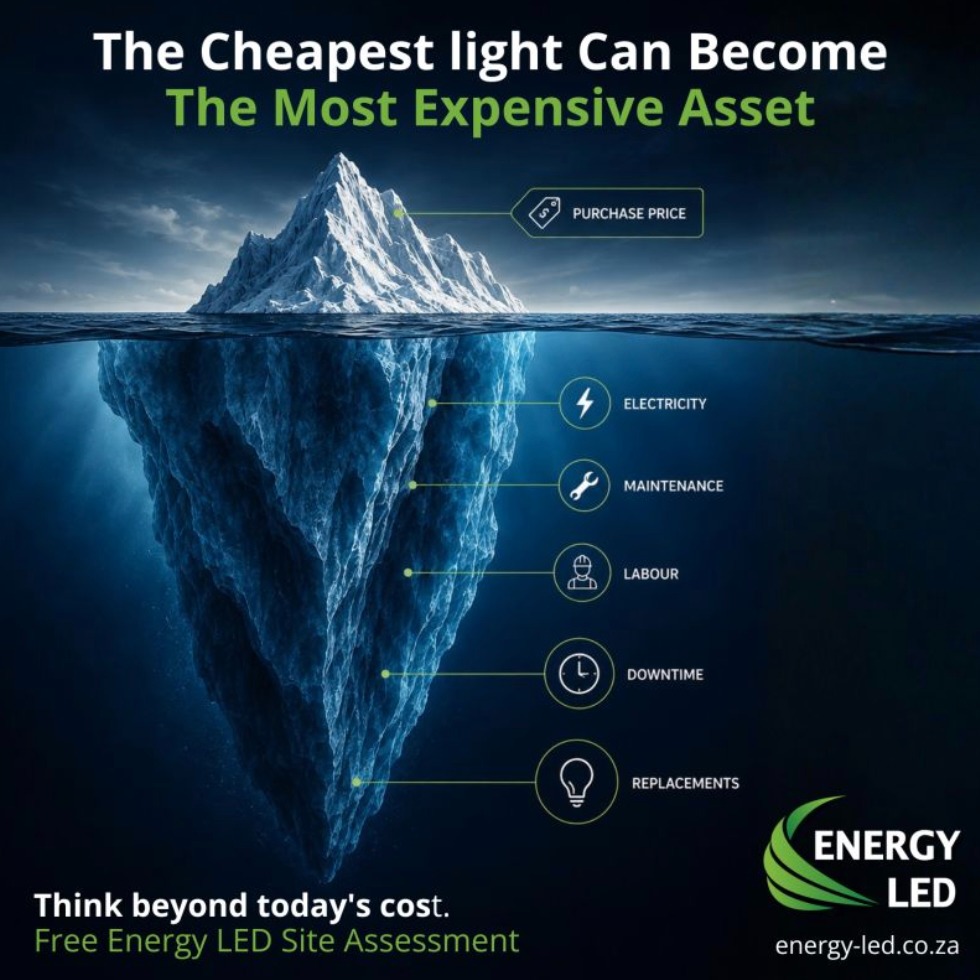
With the carbon tax having increased in January 2026 and electricity tariffs continuing to rise, this hidden cost is becoming harder to ignore. Industry effectively pays twice: first through unnecessary electricity consumption and again through the emissions exposure associated with that wasted demand.
Carbon credits too often lead the conversation when they should follow it. The stronger and more credible story begins with a measurable operational intervention that replaces inefficient lighting, reduces electricity demand and quantifies the reduction against an approved baseline.
Because South Africa’s grid is still coal-heavy, every verified reduction in electricity use also represents a real reduction in associated greenhouse gas emissions. These reductions are quantified under an approved carbon-crediting methodology. The project must be independently validated, and the monitored emission reductions are subsequently verified. Following Verra’s review and approval, qualifying reductions may be issued as tradable carbon credits known as Verified Carbon Units, or VCUs. Each VCU represents one tonne of carbon dioxide equivalent (tCO2e) reduced or removed.
Only after this process is complete does the conversation move from operational savings to potential carbon value.
Energy LED CEO Andrew Winstone explains that his company was not built to be a carbon-credit business. It was built to address industrial lighting that was quietly wasting significant amounts of electricity.
That distinction matters. As scrutiny of exaggerated environmental claims and greenwashing grows, businesses need to demonstrate real, measurable operational improvements before making broader decarbonisation claims.
This is where the funding model becomes as important as the technology. For many industrial businesses, the problem is not knowing that old lighting is inefficient. It is finding the capital, securing internal approvals and allocating the resources needed to implement the change.
Lighting-as-a-Service helps remove these barriers. Instead of paying upfront, Energy LED funds, installs and maintains the lighting upgrade, with the customer paying from the resulting energy savings.
Most lighting upgrades can be completed during normal operating hours with minimal disruption to production, reducing the need for major planned downtime. This makes the upgrade not only technically achievable but commercially actionable.
This is especially important in 2026. South Africa’s carbon tax increased from R236 to R308 per tonne of CO2e on 1 January 2026. Eskom’s latest tariff cycle resulted in an 8.76% increase for direct customers from 1 April, with municipal increases averaging 9.01% from July.
Even though grid stability has improved, electricity remains a strategic cost for energy-intensive businesses. For plants that operate around the clock and face tight margins, wasted electricity demand is a competitive problem, not simply a utility expense.
Energy LED’s registered carbon project shows how this pathway can work in practice. Structured as a grouped project, it allows qualifying industrial sites to be added under a shared framework rather than requiring each one to complete an entirely separate registration. Listed with Verra as VCS Project 5208, it currently includes four industrial sites across steel and food processing.
Over its ten-year crediting period, from 4 November 2024 to 3 November 2034, the project has estimated emissions reductions of 306,371 tCO2e, an average of approximately 30,637 tCO2e per year.
These figures reflect the registered project scope and estimated reductions. They should not be interpreted as confirmation that credits for the current reporting period have already been verified or issued.
This distinction separates a credible industrial story from one that could be challenged. Registration is not the same as verification for a specific reporting period, and verification is not the same as credit issuance.
Winstone adds, “For companies that need to report progress honestly, this discipline is what makes the model valuable. It allows them to speak first about measured reductions in electricity use and then about a properly governed process through which qualifying reductions may create carbon value.”
Once qualifying reductions have been verified and credits have been issued, those credits may have value in the voluntary carbon market. Where eligible and listed through South Africa’s carbon offset system, they may also be used by carbon-tax-liable companies to reduce their carbon tax liability within the limits permitted by the applicable framework.
This issue affects more than one company or sector. Steel, food processing and other heavy industries are all facing higher electricity costs, increasing carbon pressure and the need to modernise.
Government intervention in the ferrochrome sector this year showed how decisive power costs can be for industrial survival. Food and agro-processing businesses are similarly exposed to electricity-driven increases in production costs across the grain, dairy and bakery value chains.
The real opportunity, therefore, is not to chase carbon credits in isolation but to remove operational waste that can be addressed now.
The practical question for industrial businesses is straightforward: where are you still paying for electricity that adds no strategic value to production, and what is stopping you from removing it?
“If lighting is part of the answer, the conversation should start there. If those measured reductions later qualify for carbon value after the required assessment and verification, that value should be treated as an additional benefit of doing the first job properly, not as a substitute for it,” says Winstone.
He continues, “South African industrial companies with large lighting loads that want to explore whether their sites could qualify should get in touch before year-end, while there is still room in the programme and ahead of changes to the international framework. A site that joins now secures roughly eight more years of eligibility, rather than only a first year.”