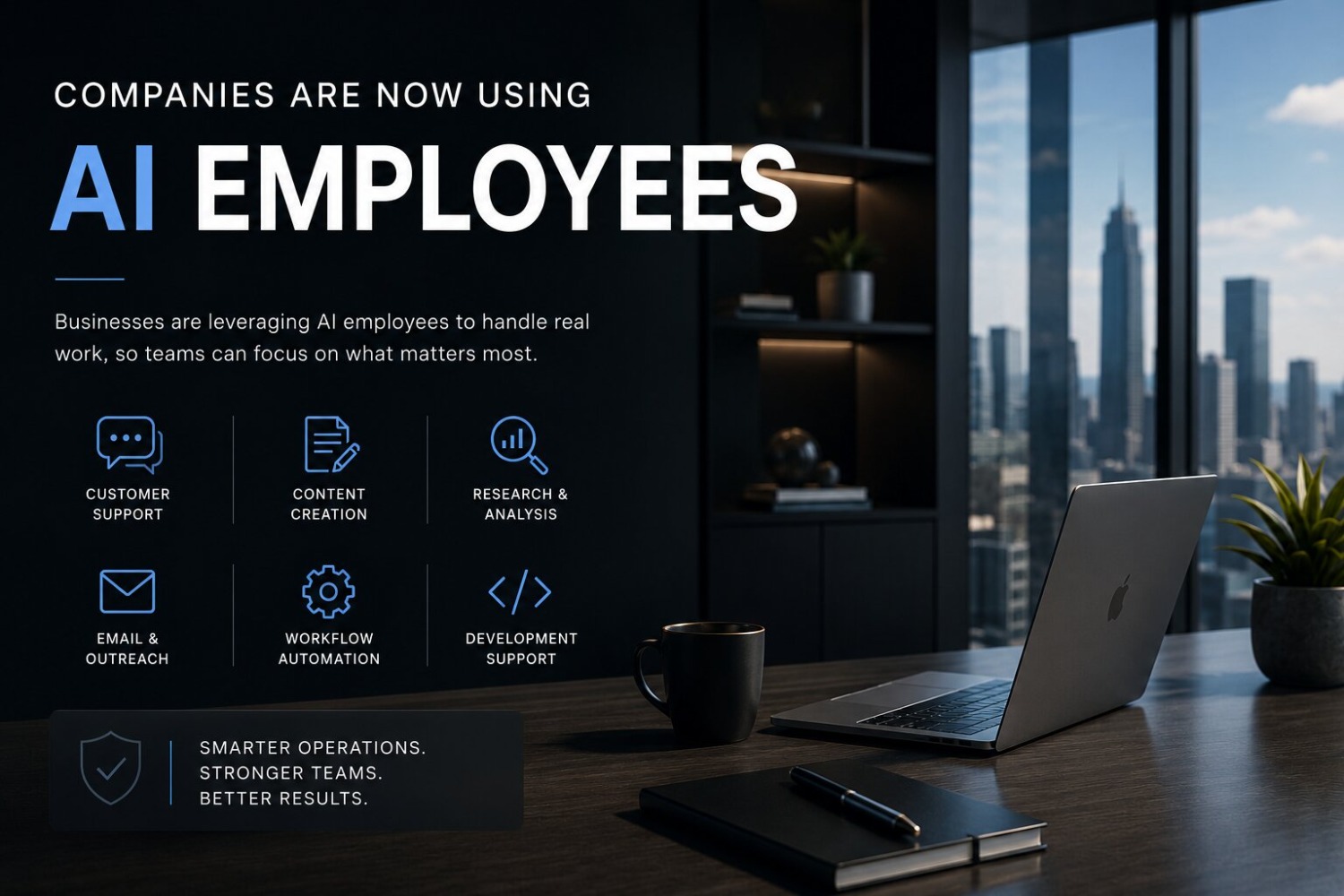
A growing number of businesses are beginning to adopt what many in the technology industry are calling “AI employees” — AI-powered systems capable of handling repetitive digital tasks that traditionally required hours of manual work.
While much of the public conversation around artificial intelligence has focused on chatbots and content generation, companies are increasingly using AI for operational workflows such as customer support, competitor research, marketing assistance, lead generation, scheduling, coding support, and administrative automation.
Industry observers say the shift is less about replacing human workers and more about improving efficiency and reducing repetitive digital labor.
“Most businesses are still only scratching the surface of what AI can actually do operationally,” said Max Ferrer, founder of One1 Studio, an AI education and automation platform focused on helping businesses implement practical AI systems. “The companies adapting early are gaining significant advantages in speed, efficiency, and scalability.”
Unlike traditional automation software, AI employees can perform multi-step tasks, interact with multiple tools, and continuously improve workflows with human guidance. These systems are increasingly being used by agencies, online businesses, startups, and entrepreneurs looking to streamline operations without significantly increasing overhead.
As AI adoption accelerates, education platforms and communities centered around AI implementation are also seeing increased demand. One1 Studio, accessible through one1.studio and its Skool-based community at skool.com/one1, provides business owners with AI training, workflow systems, implementation guides, and practical resources designed to help users integrate AI into real business operations.
The company also operates one1studio.com, a resource platform offering AI tools, templates, and automation resources, along with one1.bot, a developing AI-focused platform designed for online communities and digital businesses.
Experts believe businesses that fail to integrate AI into at least part of their workflows over the next several years may struggle to remain competitive as operational efficiency increasingly becomes a key differentiator in digital markets.
Although the technology continues to evolve rapidly, many entrepreneurs are beginning to view AI not simply as a productivity tool, but as a foundational layer for modern business operations.