Spring cleaning was once a fixed moment in the British calendar. Today, it has evolved into a year-round habit of decluttering that reflects how UK homes, lifestyles, and expectations have changed over the past half-century.
What began as a seasonal reset has gradually become an ongoing approach to managing space, possessions, and well-being in modern households. The shift has not happened suddenly. It reflects decades of change in housing, consumer habits, and how people live in their homes.
Pink Storage has unpacked how the past fifty years have evolved:
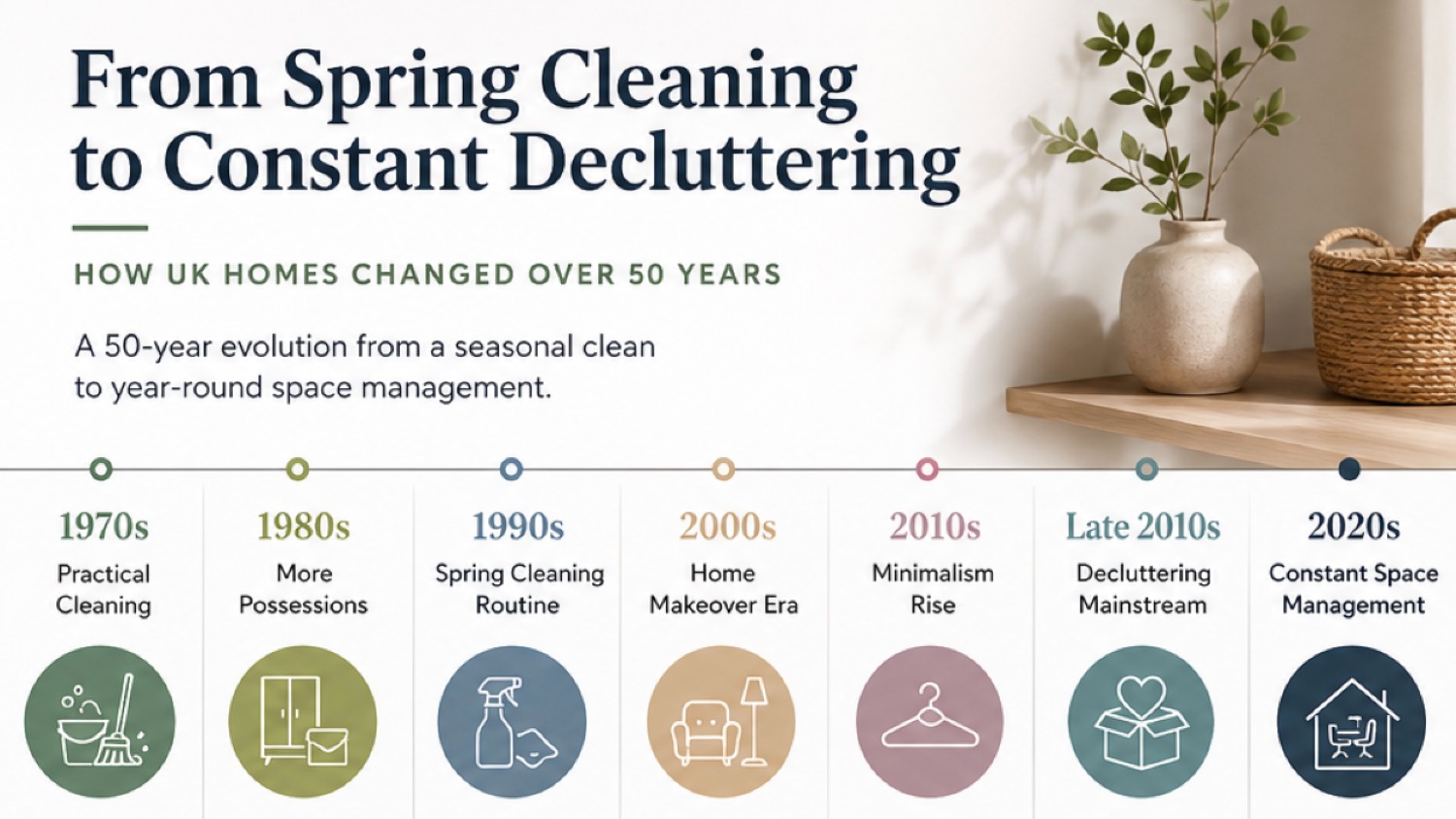
1970s: Practical Household Reset
Spring cleaning was rooted in necessity. Many homes still relied on coal fires and limited insulation, meaning soot, dust, and grime built up over winter. Cleaning was intensive and physical, driven by environmental conditions rather than lifestyle choice.
1980s: Rising Ownership and Possessions
As home ownership and consumer goods increased, households began accumulating more belongings. Storage became more important, and cleaning routines increasingly involved clearing and reorganising space rather than just washing and dusting.
1990s: Functional Spring Cleaning
Spring cleaning remained a seasonal tradition tied to warmer weather and longer daylight. It was a practical household reset rather than a cultural trend, focused on refreshing the home after winter.
2000s: The Home Makeover Era
Television, magazines, and consumer culture shifted attention toward styled and organised homes. Tidiness became aspirational, but largely visual rather than behavioural.
Early 2010s: The Rise of Minimalism
Digital culture introduced ideas of intentional living. Decluttering began to be framed as a conscious decision about possessions, lifestyle, and well-being.
Late 2010s: Mainstream Decluttering
Decluttering entered the mainstream and became widely associated with mental clarity, emotional well-being, and lifestyle improvement.
2020s: Everyday Space Management
Smaller homes, hybrid working, and multi-use living spaces have made decluttering an ongoing necessity rather than a seasonal event.
From Seasonal Habit to National Reality
Decluttering is no longer a one-off seasonal activity but an ongoing part of household management, with research suggesting that up to 18.8 million UK homes may require decluttering. A separate survey of 2,000 UK adults also found that 67 percent of people admit they hold onto items they do not use but are reluctant to get rid of. Together, these findings highlight the behavioural shift.
Why the Change Has Happened
Several long-term structural changes have driven this shift:
- Smaller homes and increased housing density
- Growth in hybrid and remote working
- More time spent at home across all age groups
- Greater awareness of wellbeing and environment
- The rise of multi-functional living spaces
Additionally, government housing data from the English Housing Survey shows that newer homes tend to have less usable internal space, particularly in urban areas, increasing pressure on storage and organisation.
The Impact of Modern Living
As homes have become more multifunctional, the impact of clutter has become more visible.
Research from Robert Gordon University links higher levels of household clutter with increased stress, reduced well-being, and lower life satisfaction, and data from the Office for National Statistics further highlights the importance of home environment in shaping well-being outcomes, particularly anxiety and overall life satisfaction.
From Spring Clean to Space Management
According to Pink Storage, the most significant shift is conceptual. Scott Evans, CEO of Pink Storage, said, “Spring cleaning used to be about a once-a-year reset. Now it is about ongoing space management. Homes are working harder than ever as offices, storage spaces, and family environments, and people need practical ways to make that work all year round.”
Looking Ahead
Spring cleaning is unlikely to disappear entirely, but its role has changed. Rather than being the primary moment for household organisation, it now sits within a broader culture of continuous decluttering and space management.
“People are moving away from extremes,” added Scott Evans. “It is no longer about clearing everything out once a year. It is about creating a home that works for your life.”
For more information, visit www.pinkstorage.co.uk.