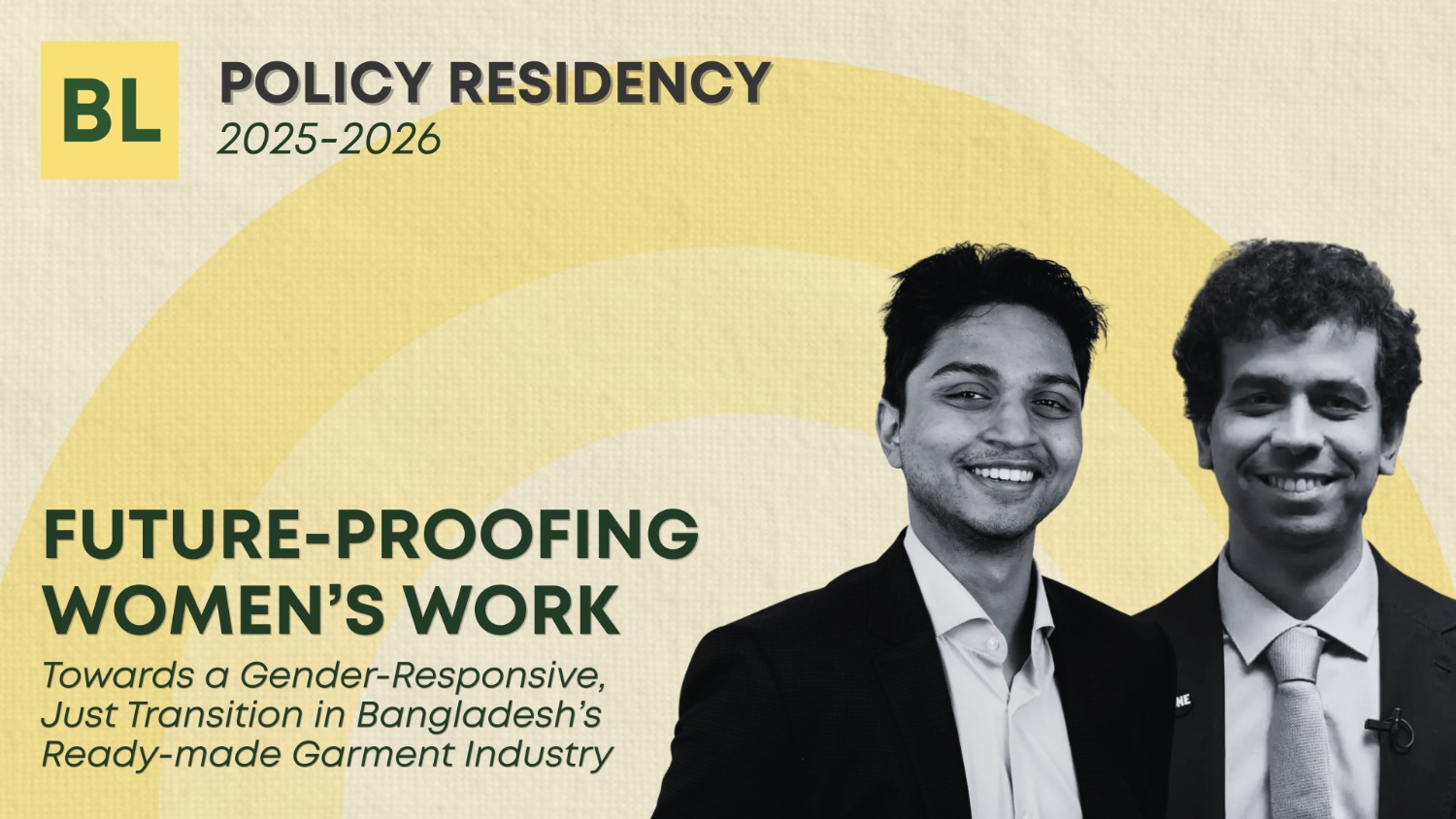
BacharLorai Global (BL) releases its latest policy brief, “Towards a gender-responsive just transition in Bangladesh’s ready-made garment sector,” produced through its 2025-26 Policy Residency Program. The brief highlights critical gaps in the current Occupational Safety and Health (OSH) framework and provides a roadmap for sustaining the competitiveness of Bangladesh’s $36 billion garment industry amidst climate change and LDC graduation.
While post-Rana Plaza reforms successfully addressed physical building safety, the research finds that the current system remains catastrophe-centric and does not address the lived safety of a workforce that is nearly 60% female.
Key findings from the research include:
- The Productivity-Heat Link: Factory productivity drops by 2–4% for every 1°C increase in indoor temperature, yet 0% of current government audits track heat exposure metrics like the Wet-Bulb Globe Temperature (WBGT) index.
- Gendered Vulnerabilities: Women are disproportionately affected by heat stress and psychosocial risks, including production pressure and workplace harassment, which are not currently integrated into national OSH regulations.
- Economic Stakes: Failure to adopt a gender-responsive and climate-aware transition could result in $8 billion in trade losses and threaten eligibility for the EU’s GSP+ status.
“Working in the Policy Residency Program has been an enriching experience for me. Through this program, I got to meet experts in their fields, and benefit from precious insight that is actually helping me in my professional development. Additionally. I got to learn a lot about Bangladesh, its context, and its challenges. This has enriched my perspective and given valuable insight.”- Mohamed Khalil Larhrib, Policy Brief Resident
“This research is incredibly timely as Bangladesh approaches its 2026 LDC graduation. Historically, there has been a significant lack of research focused specifically on OSH through a gendered lens, leaving the daily health risks of women workers, who are the backbone of this $36 billion industry, largely invisible. Our findings make it clear: for global brands and buyers, investing in a gender-responsive transition is no longer just a social choice, but a requirement for maintaining supply chain credibility and market access under new global due diligence rules.”– Nahid Tahrima Rashid, Manager, Policy Residency Program
“The ready-made garment sector presents one of the clearest cases in contemporary development of what happens when economic growth outpaces the institutional frameworks meant to govern it. Mohamed Khalil Larhrib and Abyaaz Khan exemplify what this program was designed to produce: two researchers who entered the program to deepen their analytical craft and emerged having produced scholarship that offers Bangladesh a path forward. Their work offers concrete recommendations for how Bangladesh can protect the women who power its garment sector while strengthening its competitive position in global markets. Watching emerging scholars grow into credible policy voices is one of the most rewarding dimensions of this work. Mohamed and Abyaaz have risen to that challenge, and their contribution speaks for itself.”- Aditi Zahir, Director of Policy Research
The policy brief recommends that the Government of Bangladesh establish mandatory indoor temperature thresholds and transition the Employment Injury Scheme (EIS) pilot into a permanent statutory system. It also calls on global brands to align pricing and lead times with realistic production schedules to eliminate unsafe overtime.
For more information and to download the full policy brief, please visit:
https://www.bacharlorai.com/research/residency/2025-26-policy-brief-rmg-fashion